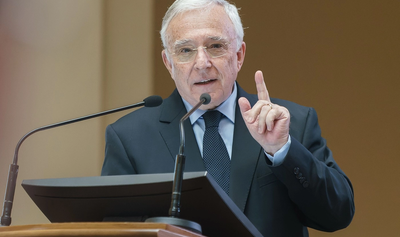


National Bank of Romania (BNR) Governor Mugur Isarescu on Tuesday rejected claims that the central bank had artificially maintained the exchange rate, saying developments in international reserves supported this view and stressing that market interventions had in fact been much smaller than a year earlier.
The governor further explained that international reserves had increased by 40 billion euros over the past five years, effectively doubling, which would have been impossible had the central bank sold large amounts of foreign currency to maintain the exchange rate artificially.
"We have not maintained the exchange rate artificially, and this is reflected in the evolution of reserves. We would have had to sell large amounts of foreign currency to keep the exchange rate artificially low, so how could international reserves have continued to rise? They have increased by 40 billion euros over the past five years - 40 billion euros, meaning they have doubled. What does this show? We intervened in the market, but mainly by buying foreign currency and preventing the leu from appreciating," Isarescu said.
According to the governor, a significant part of these operations targeted purchases of foreign currency from the Finance Ministry in order to avoid sharp exchange-rate fluctuations generated by massive sales on a relatively small foreign exchange market. Without such operations, the exchange rate would have appreciated strongly, approaching, according to a counterfactual estimate, the level of 4.4 lei per euro.
Isarescu underlined that current interventions are significantly smaller than those carried out in April-May last year and that, in the BNR's view, the exchange rate appears to have reached a market equilibrium level.
"Unlike in April-May last year, our interventions have been much smaller this time. Much, much smaller. I could even add another 'much': much, much, much smaller than last year, and the exchange rate appears to have found an equilibrium level. It may well be here. Markets can also be wrong," he said.
The governor pointed out that Romania can afford greater exchange-rate flexibility given that reserves are at an adequate level, but that future developments depend on political stability and the continuation of fiscal correction.
"Markets are very sensitive to both factors: political stability, meaning that we should have a government as soon as possible, and the continuation of fiscal correction. And let me add something else that should be remembered: often it is not only actions that cause damage, but words as well. There are moments, at least in financial history, when words are even more powerful. Words spoken carelessly or at the wrong moment," Isarescu explained.
He added that currency depreciation is transmitted rapidly into prices - by about one third - whereas appreciation is far less visible.