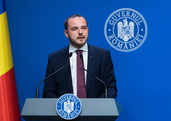
PSD chairman Sorin Grindeanu stated on Friday that the first budgetary adjustment adopted by the Niculescu Government secures the funds necessary for the payment of pensions, the financing of medicines and hospitals, as well as for social services and the settlement of debts owed to companies, according to Agerpres.
"The state must honor its obligations to ensure essential services through the end of the year. This is the purpose of the first budgetary adjustment, which the Niculescu Government adopted today under an emergency procedure. We are securing funding for medicines and hospitals. We are covering the requirements for pension payments through the end of the year. We are allocating funds for social workers, persons with disabilities, and child protection. Furthermore, we are beginning to restore liquidity to the economy by paying off debts owed to Romanian companies. However, merely putting out immediate fires is not enough. We must also determine the country's true financial situation. For this reason, a second budgetary adjustment will be necessary in mid-November, following the publication of the European Commission's official forecast and the reports from the National Institute of Statistics (INS)," Grindeanu wrote on Facebook.
Grindeanu requested a comparative analysis of the budget deficit calculated using the cash-based system versus the one calculated according to the European ESA methodology. The former reflects the difference between the actual receipts and payments made by the state, while the latter also includes payment obligations and expenses recognized in the accounts, even if they have not yet been paid.
"I want to explain very simply, even for the sake of right-wing propaganda why this is important. If a family stops paying its loan installments for six months, it might appear as though they have more money in their pockets. But that does not mean they are free of debt; it simply means they have deferred their payment obligations. The same applies to the state budget: a smaller cash deficit does not automatically mean that the state has less debt or that its financial situation has improved. I hope it is now clear enough, even for Mr. Bolojan: unpaid bills do not equate to savings! For this reason, the second budget revision must transparently show what has been paid, which obligations remain outstanding, which expenditures are already recognized under European accounting standards, and what the true state of public finances is. All state debts must be brought up to date," stated the PSD leader.
He stated that "there is no conflict" with the Minister of Finance, and that the latter "needs to bring to light" all outstanding invoices ranging from medical leave payments and VAT refunds to energy subsidies and investment projects.
"Thus, all Romanians will know our starting point and the foundations upon which next year's budget will be built. We must do this because the data published by the National Commission for Strategy and Prognosis confirm the economic consequences of recent policies: the economy is projected to shrink by 0.4% in 2026, industrial output by 3.3%, and the purchasing power of the average net wage by 3.3% the sharpest decline since the financial crisis. We are facing an economy in contraction, higher inflation, and a weaker leu. Romanians and businesses have borne the cost of austerity, yet the promised reforms and economic recovery have failed to materialize. I have stated that Romania needs a change in direction," Grindeanu affirmed.
He maintained that the PSD entered government to find economic solutions, to protect people's incomes, and to revive the economy.
"We need to know exactly where we are starting from, settle our obligations, and then shift from right-wing austerity toward economic recovery. Our objective is simple: an economy that produces more, companies capable of investing, and better-paid jobs," concluded the PSD leader.