




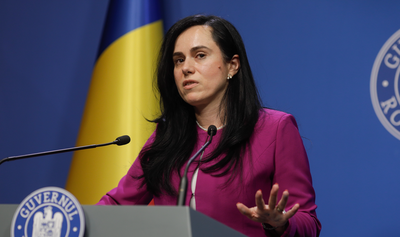


The world of work is changing faster than existing mechanisms and institutions, as artificial intelligence transforms professions, digitalisation changes the way we work, and green transition changes industries, the quaestor of the Chamber of Deputies, Simona Bucura-Oprescu, said on Monday.
"The world of work is changing faster than the mechanisms and institutions we manage. Artificial intelligence is transforming professions, digitalisation is changing the way we work, green transition is changing industries, migration is changing labour markets, and demographic developments are changing the structures of society. In this context, the essential question is how do we ensure that man does not become the variable for adjusting these transformations," said Bucura-Oprescu, at a meeting of the General Assembly of the Union of Francophone Economic and Social Councils and Similar Institutions (UCESIF).
She added that investment, competitiveness and productivity must be accompanied by trust and people's involvement in decision-making.
"First of all, we need investments, competitiveness and productivity, but we need trust and humanity alike. And trust is not built through decisions made for people, but every time through dialogue, participation, so that people, societies, feel that they are really involved in decision-making. And here, the most important role is yours, the social partners, whether you represent workers or entrepreneurs," she said.
Bucura-Oprescu also referred to demographic changes, showing that the aging of the population is one of the great challenges for the European Union.
"To us in the European Union, one of the great challenges is the ageing of the population. In Romania, between 2005 and 2025, the median age of the population increased by 8.6 years. In many African countries it is almost the opposite. Between 10 and 12 million young people enter the labour markets every year, while the economy creates about 3 million formal jobs. These are totally different realities, but they teach us the same lesson. Policies on education, employment, vocational training, social protection and economic development must always be thought out together. Here I see the greatest opportunity of the French-speaking world and of collaboration, of French-speaking cooperation. The Francophonie is a diverse space, but with an important common denominator."
The official added that social dialogue must evolve with the transformations in the world of work and include topics such as artificial intelligence, reskilling and skills development.
"We must accept that the social dialogue must change, to improve with the world of work. We can no longer talk only about pay, employment contracts and labour relations in the traditional sense. We must also talk about how much artificial intelligence, the change of algorithms in the workplace impact us. About retraining, about improving skills and competences, because jobs are transformed according to the needs of our societies," Simona Bucura-Oprescu said.
The Economic and Social Council (ESC) organises, between September 28-30, 2026, in Bucharest, a convention of the General Assembly of UCESIF and the Francophone Social Dialogue Forum dedicated to the role of representative partners of social and civic dialogue in social, economic and cultural diplomacy.
Also on Monday, the General Assembly of UCESIF took place, during which the theme of the 20th Summit of la Francophonie, "Peace, vector of sustainable development in the Francophone space", will be debated, and a UCESIF point of view will be adopted to be presented at the summit in Phnom Penh, on November 14-16, 2026.




















Comentează