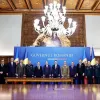
AUR lawmakers presented the party's priorities on Tuesday in response to the 10 proposals previously put forward by the PSD for a future governing program; these priorities include lowering VAT and dividend taxes, reducing the number of MPs to 300, revitalizing the energy sector and agriculture, and pursuing a "360-degree diplomacy."
AUR's specialized committees organized a conference titled "AUR's response to the 10 priorities proposed by the PSD" and "The NRRP and European funds," moderated by MP Ramona-Ioana Bruynseels.
"The PSD proposed a political program based on 10 priorities for the next two years, a document titled 'political agreement', which is intended to form the basis of the governing program for the upcoming period. (...) Unfortunately, Romania has reached its third designated prime minister; the governing program is still being drafted, while the situation on the ground is becoming increasingly difficult. Romanians tell us every day that they need concrete measures; they need to know what we plan to do next. They no longer need plans on paper, inventories, or audits presented merely for the sake of appearances. (...) Romania started with an NRRP worth 28.5 billion euros, but after renegotiation, the figure dropped to 21.4 billion and 7 billion evaporated," Bruynseels stated.
The solutions presented by AUR are not those of a "shadow cabinet" and are backed by experts, stated Petrisor Peiu, the leader of the party's senators.
"We want to show that we are a serious party. (...) We are talking about good governance. I wouldn't want you to think you are necessarily seeing a shadow cabinet, or a 'dim-light' cabinet, but we have people capable of addressing any need, including the need to be competitive against Romania's other parties. (...) The era when the PSD or PNL held a monopoly on public policy formulation in Romania is over. We offer an alternative to all these public policies, as well as an alternative to how they are integrated into a cohesive whole. Everything we discuss regarding Romania, crisis recovery programs, development, governance, takes place within a European context. We are living in a European context that has changed dramatically with the advent of the NRRP [National Recovery and Resilience Plan]. (...) We prioritize institutional and administrative reform aimed at creating a much leaner state," Peiu explained.
According to Mihai Enache, the leader of AUR's deputies, the party has several legislative proposals aimed at reducing the number of members of parliament. "AUR is ready to commit to a 50% reduction in the number of agencies, authorities, institutes, administrative bodies, centers, state-owned enterprises, and offices, with the exception of schools, hospitals, and law enforcement or defense institutions. It is somewhat difficult to take seriously a state reform program proposed by a party that has effectively become indistinguishable from the state apparatus of the last 36 years and is likely primarily responsible for the quality of public services within Romania's administration. (...) Regarding the structure of a government in which AUR might participate, we maintain the position announced in 2024: a government that includes or is formed by AUR will consist of 10 ministries and have a maximum of 50 state secretaries. We must move beyond the practice of creating ministries simply to appease a specific politician, as seen in the past. (...) Administrative-territorial reorganization is a reform that can no longer be avoided in the medium term," Enache emphasized.