





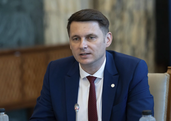
Romania will have to, in the current geopolitical context, in the short term, give importance to increasing energy efficiency and modernizing transmission and distribution networks in order to optimally use existing resources, believes the First Deputy Governor of the National Bank of Romania, Leonardo Badea.
"This new episode of escalating tensions in the Middle East brutally brings back to the center of debates the inextricable link between the dynamics of fossil fuel prices (oil, natural gas) and global economic growth. Unfortunately and somewhat surprisingly, the recent episode joins a series of relatively similar events that have occurred over the last 50-60 years. The vulnerability of transit through the Strait of Hormuz and the reconfiguration of the positions of oil-exporting states reprofile the spectrum of the oil crises of the 1970s, and the role and strategy of OPEC (Organization of the Petroleum Exporting Countries) return once again to the center of the global energy equation. From a certain perspective, the fragility of the world economy in relation to the same factors for more than 50 years is apparently incomprehensible," Badea argues, in an analysis submitted to AGERPRES on Monday.
The novelty of the current crisis is the physical disruptions to the supply of oil and liquefied natural gas (LNG), as attacks attributed to Iran knocked out approximately 17% of Qatar's LNG export capacity, generating annual losses estimated at around $20 billion and endangering deliveries to Europe and Asia.
"Returning to the Middle East crisis, according to statements given to Reuters by QatarEnergy's CEO and Energy Minister, Saad al-Kaabi, the attacks attributed to Iran have knocked out about 17% of Qatar's liquefied natural gas (LNG) export capacity, generating annual losses estimated at about $20 billion and endangering supplies to Europe and Asia. According to him, two of the 14 gas liquefaction facilities, as well as one of the two gas-to-liquids units, were damaged following unprecedented attacks. For this reason, a production capacity of about 12.8 million tons of LNG per year will remain unavailable for an estimated period of three to five years," the analysis shows.
According to the NBR official, by affecting production capacity and disrupting distribution routes, the very viability of Middle Eastern states' production is being altered. Thus, we can ask ourselves whether, in order to compensate for the financial losses and the physical damage to the infrastructures for extracting, processing and delivering oil and its derivatives, Middle Eastern states will once again resort to cartel-type policies, similar to those of the 1970s, with the implicit aim of maintaining high oil and gas prices in order to recover losses and finance the reconstruction of the infrastructure.


"In the scenario of cost transfer to economies importing oil and derived products, maintaining high hydrocarbon prices for a longer period of time through OPEC's strategy even after the end of the military conflict in the area would be equivalent to transferring the burden of restoring production capacities to OPEC clients, namely the states dependent on energy sources in the Middle East, in particular the European Union, Japan, China, India or South Korea. Therefore, in this pessimistic scenario, the inflationary surge determined by the increase in energy prices could persist for a longer period of time," specifies the deputy governor of the central bank.
At the same time, Badea continued, a possible shock to the LNG supply would have macroeconomic implications for Europe that go beyond the sphere of energy markets.
"Unlike the oil shocks of the 1970s, which mainly affected transport and logistics costs, natural gas today occupies a much more important structural position in the European economy. It represents simultaneously an essential input for energy-intensive industries and a major determinant of the marginal price of electricity in European markets. In these conditions, which are significantly different, a shock to the LNG supply must be interpreted not only as a sectoral disruption, but as a systemic shock to the cost structure of the European economy. We can start from the premise that the impact is quickly transmitted from the gas market to the electricity market, then to the energy-intensive industry and, finally, to the entire production chain in the economy. These mechanisms inevitably generate second-round effects on inflation and industrial competitiveness," he argues.
In this context, says Leonardo Badea, a question that seemed to have already been overcome in the European debate reappears: if gas becomes prohibitive, can Europe temporarily resort to fossil fuels such as coal?
"From the perspective of energy transition, such an evolution seems counterintuitive for a continent with major concerns regarding the production of green energy from renewable sources. However, economic history shows that, in situations of severe supply constraints, energy systems tend to privilege security of supply. Geopolitical developments may thus lead to energy policy decisions that temporarily contradict the optimal and meritorious logic of the long-term transition," the NBR official states.
Badea also believes that it would not be appropriate for a monetary policy response at European level to replicate today an approach similar to the Volcker model of the past.
"I believe that, in the current context, a carefully calibrated response that takes into account the more complex network of economic and financial constraints that have an impact not only on price dynamics, but also on financial stability, the dynamics of the gap between nominal and potential GDP, as well as on fiscal sustainability would be more effective. Therefore, the appropriate approach at the moment would be a 'balancing act' type, supported simultaneously by a recalibration of the macroeconomic policy mix," he said.
In his opinion, the current fiscal context in Europe is radically different from that of the Volcker period in the US. Public debt levels are much higher in many European economies, which limits the room for maneuver. Sharp increases in interest rates would amplify pressures on fiscal sustainability, could generate risks of financial fragmentation and destabilization of the macro-financial framework.
"From the macroeconomic perspective, the European economy seems to be approaching a situation that could be described as 'Energy Dominance', in which the room for manoeuvre of monetary and fiscal policies is affected. Recent energy crises suggest the emergence of a third constraint: situations in which the availability and cost of energy become the dominant factors of macroeconomic dynamics in the short and medium term, as well as conditionality for the effectiveness of monetary and fiscal policies. In a regime of 'Energy Dominance', most traditional macroeconomic stabilization instruments become less effective. Monetary policy can influence demand, and fiscal policy can redistribute the costs of adjustment, but neither source cited.
According to Leonardo Badea, this reality influences and may affect Europe's economic policy framework.
"In the new normal, we observe that macroeconomic stability depends (along with the conduct of the central bank and the fiscal discipline of governments), to an increasing extent, on the speed and extent of energy diversification, the flexibility and robustness of the energy system, as well as the energy efficiency of the economy. For Romania, this would translate into the need to continue investing in energy infrastructure (Romania currently benefits from a good diversification of energy production resources), improving and expanding nuclear capacities, exploiting resources from the Black Sea and, last but not least, maintaining at the forefront projects developed using renewable energy. At the same time, in the short term, importance must be given to increasing energy efficiency and modernizing transmission and distribution networks in order to optimally use existing resources," is the opinion of the BNR representative.
In this context, the First Deputy Governor considers that, in the current economic environment, characterized by growing tensions and volatility on international markets, Romania needs both the strengthening of a strategic choice regarding the development of energy independence, as well as instruments used for the short-term management of the economic imbalances that arise.
"Once again in recent history, we are subject to a crisis that is taking on international dimensions and affecting global distribution and supply networks," concluded Badea.




















Comentează