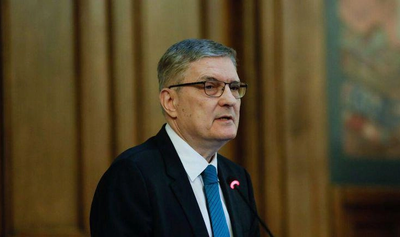


Pension indexation must be carried out with caution, given that fiscal space is very limited and Romania will have to accept that 2027 will also be a difficult year from a budgetary perspective, Daniel Daianu, chairman of the Fiscal Council, stated on Tuesday, write Agerpres.
"We cannot ignore the country's budgetary constraints. It is more than commendable that the Government is targeting a deficit approaching 5% of GDP. I agree that pensions should be indexed, but this must be done prudently. Please do not ask me for a specific figure, as I am not speaking on behalf of the Ministry of Finance. At the Fiscal Council, we express views that take into account the urgent need to avoid major budgetary deficit issues, problems that could lead to a credit rating downgrade for the country," stated Daianu during the presentation of a report on Romania's competitiveness, prepared under the coordination of former Italian Prime Minister Enrico Letta, at an event hosted by the National Bank of Romania.
Regarding the existence of fiscal space for pension indexation and the provision of energy-related relief measures, the chairman of the Fiscal Council drew attention to the need for compromises.
"No, the room for maneuver is very limited. And you should know that in economics, it's not just a matter of what economic theory says, but rather that reality itself forces you to make compromises. For instance, if you lack fiscal space and face extraordinary pressure from a certain area, to which those in government must respond in one way or another, you have to take resources from elsewhere, all while keeping the budgetary constraint in mind. These are the inevitable compromises," Daianu explained.
He emphasized the importance of adhering to budgetary constraints, in the context of Romania's reliance on external financing.
"We borrow a great deal. The Romanian government borrows from the external market, from international markets, not just from the domestic market. For quite some time, it was unable to borrow as planned in the budget drawn up for 2026, because we faced a political crisis that seemed as though it would never end. When you have such a major political crisis, it is difficult to issue Romanian bonds. Consequently, you encounter disruptions and problems in budget execution," noted the president of the Fiscal Council.
At the same time, Daniel Daianu rejected the idea that a potential downgrade of Romania's sovereign rating would have a modest impact on the economy.
"I came across an opinion, which struck me as strange, and which was even reported in the media a few days ago, suggesting that a downgrade of Romania's sovereign risk would, in fact, have only a modest impact. I thought I must have misread it. No. It would have a significant impact, because one must distinguish between a 'snapshot' of the Romanian economy, a static picture, so to speak, and the subsequent negative, dynamic effects. The dynamic consequences of a downgrade would be entirely negative; there would be no positive effects whatsoever," he argued.
He was also asked whether Romania might once again find itself in a position where it needs to seek financing from the International Monetary Fund, and Daianu advocated for prudence in the management of public finances.
"There are various scenarios regarding the life of organizations, just as there are scenarios concerning the possibilities for Romania to secure financing in the future. Ideally, we should avoid ending up once again in a position where we are compelled to seek funding from specialized institutions, which, of course, would include the European Commission. Therefore, we must strive to stand on our own two feet; and to succeed, given the highly complex international context, we must also exercise great prudence," the economist pointed out.


At the same time, Daniel Daianu assessed that there is a possibility the economy might stagnate, and that any potential contraction would be very slight.
"This year, based on the third-quarter figures, when we saw growth of over 2% I believe there is a chance we might end up somewhere around zero. In other words, if we were to experience a recession, it would be very mild. Things aren't as dire as they might seem; while the situation is still bad, it's not catastrophic. We also need to maintain a positive outlook, if we all start acting like prophets of doom, claiming that Romania is collapsing, that it's a catastrophe, or that we're standing on the edge of an abyss, well, that's simply not the case," concluded Daniel Daianu.
The report "Assessing Romania's Competitiveness: a 2027-2035 Strategic Outlook", produced by the Jacques Delors Institute and HorizonX under the coordination of former Italian Prime Minister Enrico Letta, and initiated by the Dialogue for Democracy and Development Southeast Europe Foundation (DDD Foundation), was presented on Tuesday at an event hosted by the National Bank of Romania.