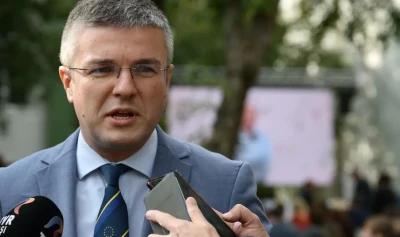


Romania's National Geological Programme, through which the country is expected to investigate and assess its mineral resources, has been unblocked after eight years on paper, interim Minister of Economy, Digitalisation, Entrepreneurship and Tourism Irineu Darau announced in a post published on his social media page on Friday, according to Agerpres.
'An act of legislation adopted in 2018: eight years during which it remained on paper because no one completed the mechanism needed to implement it. We are talking about the National Geological Programme, through which Romania should investigate and assess its mineral resources. This is an important programme for the future of our industry, but it has been stalled until now due to the lack of implementing rules. Today, the Government has just approved these rules, thereby unblocking the programme and finally allowing us to move ahead with its implementation. Why is this important? Because Romania needs a better understanding of what resources it has, where they are located and how they can be put to economic use,' Darau wrote on Facebook.
According to the minister, Romania cannot seriously discuss industrial development if it continues to rely on geological data that are decades old.
'The importance of this programme is all the greater given that critical and strategic raw materials are essential to European industry, from defence and energy to new technologies,' the official noted.
The interim minister added that the programme would update information on Romania's mineral resources through modern geological surveys; identify and assess the country's potential for critical and strategic raw materials; and investigate tailings ponds and waste rock dumps, where valuable resources may be present but have so far been treated merely as waste.
The programme is also intended to provide investors with better information, enabling them to make decisions based on up-to-date data, and to create the conditions for Romania's stronger integration into European raw material supply chains.
'There is another important point: the Ministry of Economy had allocated 5 million lei annually for this programme, but the funds could not actually be used in the absence of implementing rules. We had legislation and funding, but we did not have the mechanism needed to begin the surveys. Now, for the first time, we have that mechanism, because my approach has always been, and remains, not to accept stagnation.
'The next steps are to establish priority research objectives, allocate funding and select, through competitive procedures, the specialised entities that will carry out the work. Projects may run for up to three years, depending on their complexity.
'One important point to remember is that this does not mean we will start exploiting new deposits tomorrow. It simply means we are taking the first necessary step: establishing, through up-to-date research, what potential we have and where investment is worthwhile,' Irineu Darau stressed.