



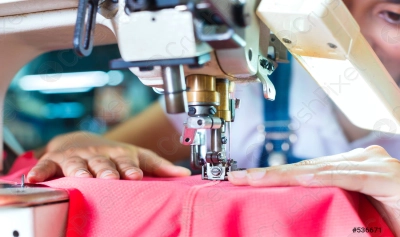


Romania's textile industry, a strategic sector with around 8,000 companies, 150,000 jobs and exports exceeding 5 billion euros, risks losing its global competitiveness without rapid investment in technologization, artificial intelligence and the circular economy, said Maria Parcalabescu, president of the Employers' Federation of the Textile, Clothing and Leather Industry (FEPAIUS), at a specialist conference on Tuesday.
"We need very large investments, and our estimate is around 800 - 900 million euros at national level - investments in artificial intelligence, robotics, technical textiles and digital supply chains. In conclusion, the transition to Textile Industry 4.0 - 5.0 represents both a major challenge and a strategic opportunity for Romania," Parcalabescu said at the 'Romania 2026 - 2040. Industry 4.0 - 5.0' conference.
In her view, the implementation of digital technologies, the development of the circular economy and adaptation to new European regulations can transform the textile sector from a low-cost model into an innovative and competitive industrial ecosystem at European level.
"The success of this transformation depends on cooperation between industry, universities and authorities, the efficient use of European funds and the development of digital skills in the workforce. Without rapid and coordinated implementation, Romania's textile industry risks losing global competitiveness. On the other hand, if these changes are strategically harnessed, the sector can become a driver of innovation and regional economic development by 2030," the FEPAIUS president explained.
According to her, several key pillars underpin the industry's development.
Thus, Pillar I is represented by retooling and smart factories. "Increasingly more companies are moving from 20 - 30-year-old equipment to integrated digital systems such as the Internet of Things for real-time production monitoring, industrial robots for automated and precise material cutting, and automation of sewing and handling processes. All these measures lead to a 20 - 30% reduction in waste. I emphasize that collaboration between universities and industry is essential for technological transfer to manufacturing plants," Parcalabescu detailed.


Pillar II envisages the circular economy, including separate collection of textile waste. "This second major pillar, the circular economy, is an area where progress will begin to be visible in 2025 - 2026. We are talking about the separate collection of textile waste, which became mandatory in January 2025. The NRRP allocates 220 million euros for recycling plants, including one national-level facility. It is a project we have already started working on together with FEPAIUS and other industry partners," she added.
Pillar III refers to artificial intelligence, considered the technology with the greatest impact. "Artificial intelligence is beginning to be used in the textile sector for generative design, automatic defect detection, material-cutting optimization, fashion trend prediction, product personalization, 3D design and virtual try-on in e-commerce," Parcalabescu said.
She emphasized that Romania's textile, clothing and leather industry is a traditional and strategic sector of the national economy, with a long history. In 2024, the sector counted 7,420 companies and approximately 150,000 jobs, while textile and clothing exports reached 5.1 billion euros.
The 'Romania 2026 - 2040. Industry 4.0-5.0' conference was organized on Tuesday by the Association for Economic and Social Studies and Forecasts (ASPES) and the Romanian Institute for Smart In


























Comentează