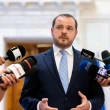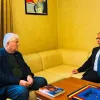


Interim Minister of Foreign Affairs Oana Toiu said on Monday that, together with her Albanian counterpart, Ferit Hoxha, she had unblocked the process for the return of the Iorga House in Saranda to the Romanian state.
"We jointly agreed on a roadmap for resolving, without further delays, the 'Iorga House' case, a property donated by the King of Albania to Nicolae Iorga and for which there have been final court rulings for almost two decades recognising the Romanian state's ownership rights," Toiu said.
She said that in 1932, King Ahmed Zogu gifted Nicolae Iorga a plot of land on the Ionian Sea coast in Saranda as a gesture of gratitude for the book in which the Romanian historian had been the first to write the history of the Albanian people.
The land was donated by Nicolae Iorga to the Romanian state two years later and the Romanian Institute in Albania was subsequently established there. Nationalised under communism and sold to a private owner in 1992, the Iorga House has, under final Albanian court rulings issued in 2007, been recognised as property of the Romanian state, but has been awaiting effective restitution for almost 20 years.
"We have now taken concrete steps and we have a clear prospect of resolving the matter," interim minister Oana Toiu said.
She added that she wished to close the Iorga House case in Saranda given that it represents "one of the finest stories of friendship between two peoples."
The interim minister said that, together with her Albanian counterpart, she had also discussed in Brussels, on the sidelines of the Foreign Affairs Council and the informal EU-Western Balkans ministerial meeting, regional connectivity including Corridor VIII, Romania's firm support for Albania's European path and common issues within the framework of the Central European Initiative, whose presidency is currently held by Romania, and the South-East European Cooperation Process (SEECP), whose presidency Romania will take over in July.
"We also spoke about the role of the Albanian community in Romania, one of the 19 recognised national minorities, as a living bridge between the two countries," Oana Toiu also said.
The Romanian Institute in Saranda operated between 1937 and 1940, until the occupation of Albania by Italy, and then again between 1942 and 1944.