



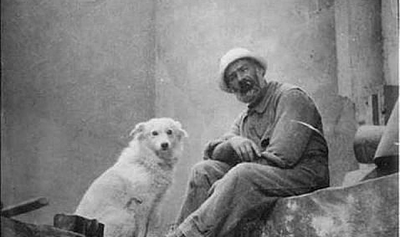


Constantin Brancusi, one of the most influential artists of the 20th century, remains a trailblazer in modern global art. Less well known, however, is that the great Romanian sculptor was also a passionate connoisseur of fine cuisine.
Literary critic and historian Cosmin Ciotlos recalls several instances where Brancusi's love of food came to light, sometimes through anecdotal passages, but always revealing.
'When it comes to Brancusi as a gourmet, we all have in mind a number of anecdotal examples. A dinner somewhere in Sarindar, for example, in the company of Pastorel Teodoreanu and a few other writers, memorable because the sculptor would wrinkle his nose at the luxurious dishes served. Or the episodes in which he would welcome foreign guests in Paris with rather fanciful dishes presented as Romanian specialities, always accompanied by champagne poured straight into yoghurt jars. In 1922, he travelled with Raymond Radiguet to Corsica, continually searching for a fish soup he truly liked. Reginald Pollack recounts that Brancusi, without pretension (though surely with a touch of humour), presented himself as one of the world's greatest chefs and that, one afternoon, dissatisfied with his hosts' menu, he rushed to his studio and returned with a splendid roast leg of lamb, which he preferred to the beef tongue that he dismissed as mere cat food',' Cosmin Ciotlos told AGERPRES.
Ciotlos points out that Brancusi had the opportunity to learn gastronomy in the places where he worked after leaving his native village, Hobita, in Gorj County.
'These are all amusing little stories, but I do believe this passion of him was akin to a workshop, a laboratory, a crucible - a mindset he also intensely cultivated in his art. It is well known that in his last fifteen years, roughly after the Second World War, he did nothing but rearrange, again and again, his studio on Impasse Ronsin, paying attention like no one else to light, motion, and the volumetric dialogue of the works - as important to him as the sculptures themselves. A space of intimacy, sanctified by the work it contained. Preserving proportions, it is reasonable to assume that Brancusi's gastronomic passion encompassed not just the result, but above all the process: we are talking about someone who, having fled his native Hobita, started working in 1888 at the Spirtaru brothers' tavern in Craiova up to 18 hours a day, and who, upon arriving in France, supported himself washing dishes in the kitchen of a large restaurant,' Ciotlos emphasised.
In his book "Colectionarul de sarmale" ('The Cabbage Roll Collector'), writer Cosmin Dragomir devotes a chapter, 'Brancusi, Culinary Critic', to the sculptor, quoting a text by Vintila Rusu Sirianu from "Vinurile lor"/"There Wines", describing a dinner attended by Brancusi.
'Perhaps you didn't know, but Brancusi was a gourmand and an accomplished gourmet. He loved food, and Romanian cuisine in particular, which he often referenced in his correspondence. (...) There is a moment when, questioned by his fellow diners, Brancusi speaks at the table and reveals his skills as a culinary critic. It was around 1924. (...) Brancusi, Vinea, Darascu, Camil Ressu were at dinner, and they were joined by us, who were inseparable: Cezar Petrescu, Pastorel, and myself. Pastorel, who felt at home in the great restaurants and taverns', arranged an extra' dinner at the Modern. (...) Brancusi visibly enjoyed being among us. (...) After the pickled fish, Pastorel, who had arranged the dishes according to Romanian culinary tradition, imprudently asked Brancusi if he liked the fish. He replied briefly, seemingly pleased to be asked: It's farmed carp. A bit fatty. Quite 'aromatic'... the pickle is a bit long.' He smiled slyly and concluded: Otherwise, it's fine...' (...) How did you like the vegetable stew, master?' Brancusi pierced him briefly with a sidelong glance: The cook made an effort. But effort alone isn't enough. Too much carrot. Cooked over too high a heat. (...) With the pork skewers stuffed with bacon and garlic, coated in cornmeal, we were all satisfied.' Upon tasting two bites, Brancusi muttered under his breath, raising his fork as an exclamation: That's good!''


Dragomir notes that Brancusi left no records or recipes of traditional dishes.
'Unfortunately, from Brancusi we do not have a cookbook or substantial notes that could have served as the basis for such a book, which surely would have been an international bestseller and would have brought Oltenian gastronomy back into the spotlight, deserving far more attention than it currently receives. As a cookbook author, Brancusi would have joined a list of great artists whose names are associated with such publications: from Dali to Frida Kahlo, from Claude Monet to Georgia O'Keeffe, from Hemingway to Dumas. We learn about Brancusi's culinary skills from contemporaries who dined with him, from his correspondence, and other testimonies collected by his biographers. Some of the most memorable stories come from the Modern restaurant (later Berlin, today Control), where he even impressed the gourmet godfather Pastorel Teodoreanu,' Dragomir added.
Brancusi was influenced both by traditional Romanian cuisine and by what he discovered in Paris.
According to the management of the Buzau County Museum, which recently organised the event 'Recipe Notebook', aimed, among other things, at celebrating and transmitting Romanian culinary identity, Brancusi's gastronomy reflects not only food but a certain philosophy of life.
'Gastronomy in Brancusi's time points to two worlds that shaped the artist's life: the Romanian village he came from and modern Paris, where he established himself. In his childhood in Hobita, his diet was certainly simple, as in any Romanian village, aligned with the seasons, work, and religious fasting. This was a cuisine of essentials, based on polenta, bread, beans, cabbage, onions, milk, cheese, eggs, and occasionally meat, especially at holidays. It was a sober gastronomy, yet deeply connected to community, tradition, and purpose. Later, in the big cities and then in Paris, Brancusi encountered a different culinary culture, much more diverse and refined. Early 20th-century Paris was a space of cafes, restaurants, conversation, and the art of living. Yet even living in this sophisticated world, Brancusi remained, in sensibility, close to his original simplicity. Thus, when we speak of gastronomy in Brancusi's time, we are talking not only about food but also about a philosophy of life: respect for ingredients, simplicity, balance, and authenticity. In the same way Brancusi sought essence in sculpture, so too did the world he came from cultivate the essential in food,' Daniel Costache, director of the Buzau County Museum, told AGERPRES.




















Comentează