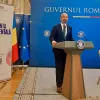
Education Minister Sorin Costreie said on Friday that a gulf was emerging and widening between rural and urban Romania, with one part of the country enjoying living standards comparable to those abroad and another left behind, where outdoor toilets remain commonplace and children go to school hungry, warning that this divide must be narrowed.
The education minister attended the opening of the sixth edition of the Forum of Romanian Youth from Around the World at the Cotroceni Presidential Palace, alongside President Nicusor Dan and Prime Minister Luca Niculescu. The event was organised by the Romanian Youth Forum Federation, the League of Romanian Students Abroad and the Union of Romanian Students, agerpres reports.
"Looking around this room, I feel much better, and I feel what I haven't been able to experience these past few days, namely going to teach my classes. I regret that and will make up for it, but a number of important problems have arisen. I want to personally thank the president and the prime minister for immediately understanding the situation and supporting education as we deal with the problems we face, particularly violence in schools. (...) I want us to turn schools that are left to cope on their own into safe schools," Costreie said.
He noted that he had 30 years of teaching experience in academia, including more than a decade abroad, before returning to Romania in 2008.
"I returned in 2008 full of hope, and four months later the crisis struck. My already modest salary as a university lecturer was cut, and I had to give a great deal of private tuition, but let's not dwell on that. I have no regrets. I came back partly for personal reasons, but also because, although the future I had envisaged abroad was that of a reasonably successful researcher and teacher, I felt there was much more I could do in Romania. And now, two things: have confidence and be patient. As long as you identify with Romanians everywhere, as long as you feel Romanian, whether you are here or abroad, and Romania is home to you wherever you may be, I believe you are exactly where you should be," Costreie told the young Romanians living abroad.
According to the minister, reducing development disparities between rural and urban areas is a national priority.
"The Romania we know today is much closer to what life abroad was like a few years ago, and all of us here have worked to bring those standards home. The problem I see today is that, for example, and this is quite straightforward, the Bucharest-Ilfov region has a higher GDP per capita than the Berlin-Brandenburg region. That is an economic fact. I know it may be hard to believe, but there are several such examples.
"The problem is this gulf that is emerging and widening within Romania itself. The Romania that has achieved normal living standards is much closer to the Romania we once saw abroad. But the Romania that has been left behind, the Romania of outdoor toilets, of children who have nothing to eat when they go to school, of rural communities and the many disadvantages faced by those living there, is much further removed from the rest of us. I believe we must recognise the extent of this divide," the minister said.


Costreie invited the young participants to consider working at the ministry, saying he needed people with expertise in law, IT, artificial intelligence and procurement.
"There is a great deal to be done, so come forward with confidence. And I will make you my first offer, because although we took office two days ago, I have not yet managed to put together my team or restructure the ministry. I am absolutely serious: I am looking for people with experience and backgrounds in law, IT and AI, even procurement, which is a problem in virtually every ministry, as well as many other fields.
"I welcome your applications and promise to examine your CVs very carefully, given the circumstances in which we are currently working. In 2026, I was a state secretary and had four advisers. Now I am a minister and have three. I won't dwell on that, but we must do everything we can with the resources available.
"Why? Because we want to bring the Romania we still regard as existing abroad, and which remains something of a distant dream, into Romania itself. And as I have said, Romania must become as united as possible. This source of social tension that now exists between rural and urban areas, between advantaged and disadvantaged communities, must be reduced, because otherwise it will completely disrupt our society and all the dreams and plans we have for Romania," Costreie added.
More than 150 young people from Romania and the diaspora will take part in the six-day Forum of Romanian Youth from Around the World, attending activities aimed at identifying practical solutions to issues affecting them. Participants will develop specific proposals for legislative changes in areas ranging from education and the labour market to justice and relations with the Romanian diaspora.