



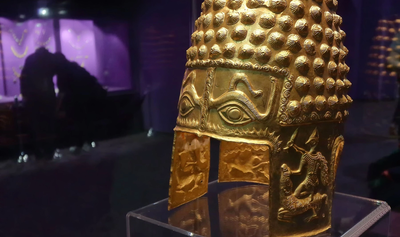


The violent attack on archaeological masterpieces such as the Cotofenesti Helmet and the three Dacian royal gold bracelets is an exceptionally serious attack on cultural heritage, public trust and the dignity of a people, the National Museum of History of Romania (MNIR) said in a statement presented at the trial in Assen, the Netherlands, where the perpetrators of the theft from the Drents Museum are on trial. The document was also published on the institution's Facebook page.
"Honorable Court, on the night of January 24 to 25, 2025, there was not just a burglary with explosives in a museum. There was a violent attack on archaeological masterpieces: the Cotofenesti Helmet and three royal Dacian gold bracelets, exhibited as part of an international museum collaboration. These pieces are not simple material goods. They are heritage assets of exceptional importance, classified in the Treasury, and their documentary, artistic and symbolic value goes beyond the borders of a single state. They belong to the cultural memory of Romania, but also to the cultural heritage of humanity," MNIR representatives said on Tuesday, in a statement read by a representative of the Dutch prosecutor's office.
MNIR emphasizes that the theft caused a profound trauma in Romanian society and professional, moral and human damage to the institution.
"The Cotofenesti helmet is not only known to specialists. For entire generations, it has become an image of historical origins, a landmark of cultural continuity and dignity. Therefore, its disappearance was not perceived as the loss of an object, but as a wound to the collective memory. For millions of Romanian citizens, the news of the theft produced shock, revolt, humiliation and the feeling that a part of their past was violently torn from the public space and exposed to the risk of being destroyed forever. (...) These pieces have been preserved, researched, protected and passed on through the work of museographers, archaeologists and historians. Behind each object are decades of public responsibility, scientific work and institutional effort. the statement states.
The MNIR shows that the effects of the theft went far beyond the museum's borders, affecting international cultural cooperation.
"This theft has seriously damaged the trust on which cultural cooperation between European institutions and beyond is based. International exhibitions exist to bring peoples closer, to create mutual respect and to make heritage accessible to the general public. Instead of this purpose, this act has generated fear, suspicion and immense public tension. It has put pressure on cultural relations between institutions, affected the trust necessary for future museum loans and produced a shock wave throughout the world of heritage. (...) In the public space, this dramatic event has fueled anger, distrust and hostile discourses towards the MNIR staff and towards the very generous idea of international cultural exchanges. The theft was perceived as a national humiliation and was exploited to amplify tensions, frustrations and reflexes of rejection, anti-European sentiments," the MNIR transmitted.
The institution emphasizes that the court is not just trying a theft, but the consequences of an act that has deeply disturbed a society and weakened, even temporarily, the trust between communities that should support each other. MNIR expresses its confidence that the Romanian authorities will continue their efforts to recover and mitigate the effects of this incident.


"The exceptional gravity of the acts also results from the nature of the objects targeted. In the case of archaeological heritage of this rank, the damage cannot be measured only in market value nor fully repaired by simple material recovery. Such objects cannot be replaced! They carry within themselves unrepeatable historical information, identity significance and a symbolic value that no amount of money can reconstruct. When such assets disappear, even temporarily, the entire community is deprived of access to a part of its own memory. Therefore, we ask you to appreciate these acts not as an ordinary patrimonial crime, but as an exceptionally serious attack against the cultural heritage, public trust and dignity of a people. When such a treasure is savagely attacked, not only Romania is hurt. European memory is hurt and the very idea that the great creations of the past must be preserved is affected. preserved and transmitted intact to future generations. For all these reasons, the National Museum of History of Romania has the belief that you will judge with all the firmness required by the gravity of the facts and the consequences generated by them", the MNIR statement also states in the trial in Assen, the Netherlands, in which the perpetrators of the theft from the Drents Museum are being tried.




























Comentează