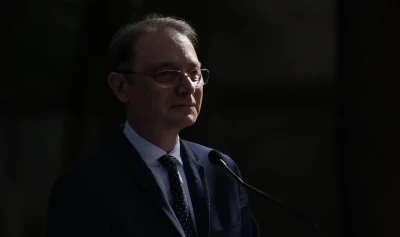


Prime Minister-designate Luca Niculescu submitted the list of ministers and the government program to Parliament on Thursday evening. The program, prepared for the 2025-2028 period, "focuses on execution: clear directions, concrete measures, and results that citizens can verify," proposing a shift "from an economy based on imports and cheap labor to one based on domestic production, innovation, and technology, and from a predominantly quantitative budgetary adjustment to a qualitative consolidation." Reducing the deficit through more efficient spending, improved tax collection, and combating large-scale tax evasion, while protecting investments, production, and purchasing power are key-components of the program, with the ultimate goal of a stronger economy capable of sustaining a smaller deficit and a manageable debt level.
Budgetary responsibility is an essential element: "We implement the program in line with the deficit-reduction trajectory committed to under the 2025-2031 National Medium-Term Structural-Fiscal Plan. Measures with a budgetary impact will only be included in the annual budget if their costs and funding sources are publicly justified. We will prioritize the use of European funds, guarantees, equity instruments, and public-private partnerships," the document states.
The program mentions "prudent pension indexation starting in 2027, consistent with the deficit-reduction trajectory," as well as the reform of property taxation, involving a gradual transition toward market-based valuation by the end of the consolidation process.
As to the Economy and the Business Milieu, companies are promised a legislative package designed to reduce administrative burdens by at least 25% and authorization timelines by at least 30%, relative to the baseline measured at the start of the mandate. Niculescu commits to not selling off profitable state-owned assets, though he mentions the possibility of listing minority equity stakes.
The National Authority for the Defense Industry (ANIA) is to be established under the authority of the Prime Minister. It will coordinate both state-owned and private operators, overseeing areas such as industrial policy, authorization, licensing, and control of military and dual-use products, industrial cooperation, technology transfer, access to European funding, and research and development aligned with defense procurement needs.
In the Energy sector, the Government aims to develop new production capacities: over 5,000 MW of new capacity by the end of 2027, along with approximately 8 billion cubic meters of natural gas annually from the Black Sea. The goal is for Romania to become less dependent on expensive electricity imports by the end of 2028.
For the Defense sector, a public annual growth schedule will be established, extending to 2035, in line with the NATO commitment made in The Hague. This will include a 3.5% / 1.5% breakdown, reported separately in each annual budget, with funding for this growth aligned with the agreed-upon deficit trajectory. "Each increase corresponds to specific capabilities and timelines outlined in the Multiannual Armament Plan and the 'Romanian Army 2040' Program, prioritizing air and missile defense, naval capabilities, unmanned systems, and ammunition, while also covering operational, maintenance, and training costs. We publish an annual status update on the funded programs."


Regarding security in the Black Sea, the program states: "We are expanding defense cooperation with NATO and EU partners, notably France, Germany, Italy, Poland, the United Kingdom, and Turkey, to enhance Black Sea security through joint training, procurement, and logistical support initiatives. We continue our participation in the Mine Countermeasures Task Group in the Black Sea (MCM Black Sea), established by Romania, Turkey, and Bulgaria in 2024."
Furthermore, the document notes: "We are deepening our Strategic Partnership with the U.S. across all dimensions, maintaining the essential role of the United States in Romania's security. For the first half of 2027, we propose a portfolio of joint projects spanning energy (including nuclear), defense, artificial intelligence, semiconductors, cybersecurity, and critical infrastructure. We aim to integrate Romanian suppliers into transatlantic industrial supply chains and cooperate on critical minerals, leveraging private capital, U.S. and European financial instruments, as well as funding from the EIB (European Investment Bank) and the EBRD (European Bank for Reconstruction and Development), without requiring a new, broad budgetary allocation. We are also expanding people-to-people, educational, and scientific ties."