



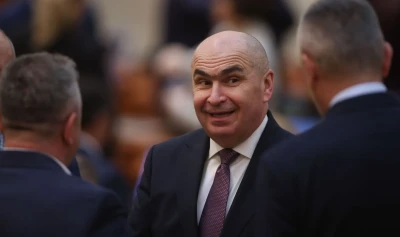


Prime Minister Ilie Bolojan said on Wednesday that the technical connection permits blocking or raising the cost of access to Romania's energy networks must be abolished, arguing that around 90% of the projects behind them are speculative and never intended to be developed.
Bolojan said the energy system needs to be "debugged" of these permits, which have accumulated far beyond the country's real consumption needs. "We are in a situation where, compared to approximately 9,000 MW of daily power that the Romanian economy needs, we issued technical connection permits for over 78,000 MW at the end of last year, and this spring we reached 80,000 MW, almost ten times the power we need," he said at Victoria Palace.
Most of these permits were issued in the past three years, yet "less than 10% of them have advanced", the prime minister added. "Of the 80,000 MW, only around 8,000 MW have moved forward. This means that 90% of these projects are speculative in nature. Those who obtained these projects do not intend to develop them and are only looking to sell them. They would not be viable anyway, because exceeding our consumption many times over, there is no one to sell this hypothetical energy to."
As a result, Bolojan said, serious investors with financing are forced either to buy speculative projects from those holding the permits or to pay additional costs to secure access to the grid.
He blamed permissive regulations for enabling this situation. For years, he said, there were no guarantees required from applicants. Since 2024, National Energy Regulatory Authority (ANRE) introduced guarantees, but they represent only 5% of the connection value, not of the investment value, making them "quite low". Deadlines were also extended repeatedly, and the lack of competitive procedures allowed approvals to be issued inconsistently. Transelectrica, he noted, issued more than 2.3% of the total power amounts tied to these permits, often depending on "the dynamics and the contacts" with the company.
Bolojan also pointed to side effects in agriculture. "We have dozens of hectares of land formally removed from the agricultural circuit, without any investments being made on them," he said. Although some regulations have been amended, they were not sufficient to cancel existing permits. "Even if last year approximately 8,500 MW reached their term, in total we still have 80,000 MW, and we can no longer continue like this."


The prime minister said the solution is to tighten regulations, significantly increase guarantees, and impose firm deadlines for obtaining documentation and starting investments. If deadlines are not met, "those who deposited the guarantee must lose it in favor of Transelectrica or the other network owners, or in favor of the state."
Bolojan noted that ANRE has just concluded a public consultation on modifying the regulation, but the proposed increase of guarantees from 5% to 20% of the connection value remains insufficient. "Next week, when a debate will take place on this topic, the government will communicate its proposals to ANRE, requesting their inclusion in the new regulation, so that by the end of this month we have the new regulation published," he said.
The prime minister cited Spain as an example of a country with clear rules and strong performance in photovoltaics. Romania, he argued, should require guarantees of around 10% of the investment value, similar to those required from builders participating in public tenders. With higher guarantees and short deadlines, "we could have a number of technical connection approvals remaining on the market that represent serious companies, which have financing and that we will see realized."
Such measures would free up the networks and allow credible investors to proceed. "But for this, we need to rid our networks of these technical connection approvals," he said, adding that the new regulation must be adopted by the end of the month.
Bolojan also emphasized the need for a clear strategy from Transelectrica regarding Romania's real needs. "We need to establish exactly where we need photovoltaics, if we need them, where we need storage, and not let some people identify an area they can submit a project for, because instead of limiting imbalances, we complicate them even more," he concluded.
























Comentează