



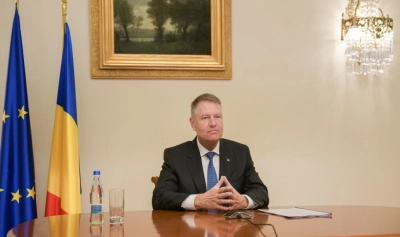
In a speech to a special meeting of the European Council, held on Thursday and Friday via videoconference, Romania's President said that the vaccination certificate should be used for medical purposes.
"Regarding the vaccination certificates, the President of Romania called for a coordinated and uniform approach at the European level, arguing that the vaccination certificate should be used for medical purposes, and the process of identifying the technical elements contained in a European certificate will have to continue," the Romanian Presidential Administration said in a press statement released on Friday.
Discussions at the European Council focused on European Union (EU) coordination amidst the ongoing COVID-19 pandemic and health action, focusing on lessons learned from the current crisis, strengthening EU resilience in health and crisis management, in an attempt to create a Health Union, as well as international co-operation in the area. European leaders also discussed security and defence, with emphasis on EU co-operation and complementariness with international action, as well as on the Union's Southern Neighbourhood.
In a statement adopted by the meeting, the EU leaders underlined the importance of conducting national vaccination campaigns under the best circumstances and maintaining the integrity of the EU's internal market. Particular attention was paid to strengthening the ability to identify new variants of the COVID-19 virus and adapting vaccines accordingly. The heads of State or government also exchanged views on the current situation and lessons learned from the pandemic to strengthen EU resilience in the area based on recent European Commission proposals on a Health Union and a pharmaceutical strategy.
In his speech, Iohannis mentioned the conclusions that emerge as a result of the process of managing the COVID-19 pandemic since its inception a year ago. He praised the European Commission for its efforts to manage the pandemic, in terms of the purchase and distribution of vaccines, to secure the operation of the EU's internal market, to put forth initiatives to strengthen EU resilience in the area, such as the recent European Health Emergency Preparedness and Response Authority (HERA) Incubator for joint anticipation of COVID-19 variants.
The Presidential Administration points out that, in connection with the vaccination process, Iohannis emphasised that, despite delays in the delivery of vaccines and different vaccination paces in the member states, developments are positive at European level, with vaccinations taking place as planned.
"On the other hand, President Klaus Iohannis pointed out that, at the EU level, it has not been possible for a common approach to some pandemic measures, such as restrictions, which differ significantly from one member state to another in terms of border control or ensuring the free movement of goods and persons."
The Romanian head of state called for the operationalisation of the European vaccine donation mechanism to support third countries as soon as possible. He referenced Romania's unveiled support for Moldova, namely the donation of 200,000 doses of vaccine, noting that national legislation has been approved for the donation, at a first stage, of over 20,000 doses to neighbouring Moldova.
"President Klaus Iohannis emphasised that, in the event of possible future similar crises, the lessons learned from the current pandemic are very important, so the experience gained during this period must be put to good use. Given that the pandemic is global, while the powers in the field of healthcare are national, the President of Romania voiced support for the need to improve the European healthcare architecture in order to contribute to the consolidation of the European Union. In the same context, President Klaus Iohannis called for the improvement of existing bodies and mechanisms for better protection, prevention, preparedness and response at EU level in the event of dangers to human health," the Presidential Administration also shows.
Another topic addressed by the EU leaders related to the EU's security and defence in a particular context marked by significant developments at European and global level that include a change in the US leadership, the completion of the process of the UK withdrawing from the European Union, launching some internal processes of strategic reflection on common defence and security policy.
In the adopted statement, the European leaders say they are committed to cooperating closely with NATO, in full respect of the principles set out in the treaties and those agreed by the European Council, and to strengthening their partnerships with the UN and key regional partners, while looking forward to cooperating with the new United States administration on a strong and ambitious transatlantic agenda that includes a close dialogue on security and defence.
According to the Presidential Administration, Iohannis pointed out that Romania remains committed to the EU's security and defence efforts to promote the EU's interests and values, as well as to strengthening its capacity to manage threats and challenges to security.
The chief of state also underscored that Romania supports the implementation of the EU's initiatives in the field of security and defence, while ensuring full complementariness with NATO, which remains the foundation of collective defence for those EU member states that are NATO members as well.
He voiced strong support for strengthening the political dialogue and further developing the EU-NATO strategic partnership, underscoring that the transatlantic relationship is essential to the security of the EU.
Regarding the Strategic Compass process, President Iohannis mentioned that it was an opportunity to define and strengthen the EU's security and defence efforts.
The chief of state argued that the forthcoming Conference on the Future of the EU should identify ways in which the EU can become stronger, including globally. He mentioned the need for the EU to have, in addition to a strong economy, a strong security and defence policy, as well as a strong foreign policy. He emphasised that the key component of the EU's action must be the unity of the EU as a source of its strength, both internally and externally.
On the Southern Neighbourhood, the European leaders exchanged views on the European Commission's recent communication on a "New Agenda for the Mediterranean," which calls for a renewed partnership with the Southern Neighbourhood states and meets the strategic goal of ensuring a stable, secure, democratic and prosperous neighbourhood of the EU.
President Iohannis: The vaccination certificate should be used for medical purposes
Sursă foto: digi24.ro
Distribuie articolul


Distribuie articolul


București 3°C
3°C
3°CArticole Similare
22
Foraj Sonde Videle acquires Raffles Energy and Zenith Resources; deal expected to close by end-August
22
26
Football icon Mircea Lucescu laid to rest with military honors
26
11
CCIR president urges shift from Chinese commercial presence to real investments in Romania
11

14
Philip Morris International Presents its Value Report 2025: change in motion
14
34
Tennis player Sorana Cirstea qualifies for semifinals of doubles event in Linz (WTA)
34
17
Romania men's national water polo team at third consecutive win in World Cup's Division II
17
20
Romania women's tennis team wins first match against France in Billie Jean King Cup
20
20
BNR's Badea: Euro adoption, a strategic goal tied to Romania's economic integration and institutional maturation
20
21
Roxana Minzatu: Erasmus mobility must be right for all, not just a chance for privileged
21
8
Gov't approves Romania's annual contribution to the Hague Conference on Private International Law
8
13
Transport minister signs financing contracts aimed at acquisition of electric vehicles and development of charging infrastructure
13
11
Most indices on the Bucharest Stock Exchange closed Thursday's trading session in positive territory
11
12
Transport minister: Softronic to complete 19-locomotive modernization contract ahead of schedule
12






Comentează