



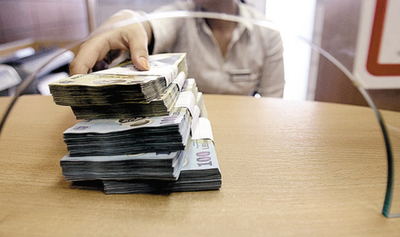


The Ministry of Finance borrowed 4.7 billion euros from foreign markets following a bond issue launched on July 9, but borrowing costs, although decreasing, remain high, the institution announced on Friday in a statement.
"This month, Romania carried out one of the most important financial operations in recent years on international markets. Following the Eurobond issue of July 9, 2025, the Ministry of Finance attracted, through borrowing from foreign markets, a total amount of 4.7 billion euros equivalent. This is the third such transaction carried out in 2025, and the total amount is the largest attracted this year. Borrowing costs, although decreasing, remain high," the quoted source stated.
According to the Ministry of Finance, the issue registered considerable interest from investors, with total demand being over 9.5 billion dollars for the dollar tranches and over 4.5 billion euros for the euro tranche (amounts that do not include demand from intermediary banks). According to the Ministry of Finance, the issue registered considerable interest from investors, with total demand being over 9.5 billion dollars for the dollar tranches and over 4.5 billion euros for the euro tranche (amounts that do not include demand from intermediary banks).
Romania's bonds were oversubscribed by almost 2.8 times. A total of over 240 investors participated, and the funds attracted were settled on July 16, 2025.
"The success of this issue is also marked by the financial conditions obtained. In the process, based on the accelerated growth of purchase orders from investors, Romania managed to reduce the initial costs of the loan. The risk margins (spreads) compared to the references considered (US bonds at similar maturities and the level of swap rates in euro) were reduced by 40 basis points for all tranches. Also, for the 5-year USD bonds, the state did not pay any additional premium, and for the 10-year bonds and for the euro tranche, negative premiums of 3 and 10 basis points were recorded, respectively, which means that Romania borrowed at a lower cost than that of the secondary market," explains the document sent by Finance.
This transaction is part of Romania's strategy to finance itself externally in 2025, ensuring both the coverage of financing needs and the consolidation of the state's foreign exchange reserves.
In this context, the Minister of Finance, Alexandru Nazare, pointed out that the issuance after a period marked by political and economic uncertainties and in a challenging geopolitical context reconfirmed investors' positive perception of the first package of fiscal measures and the Government's capacity to continue implementing reforms.
"This success of Romania on international capital markets reconfirms investors' confidence in Romania's capacity to implement and continue to take the necessary measures to correct current imbalances. The issuance after a period marked by political and economic uncertainties and in a challenging geopolitical context reconfirmed investors' positive perception of the first package of measures approved, as well as of the capacity to continue implementing the necessary reforms that will contribute to Romania's fiscal sustainability," said Alexandru Nazare, quoted in the press release.


The Eurobond issue benefited from a very diversified investment base, both geographically and in terms of investor types.
In terms of investor types, for both dollar-denominated tranches, the preponderance of "real money" investors is evident, namely privately managed asset funds, which had a share of 76% and 80% in the 5- and 10-year maturities, respectively. Pension funds and insurance companies had a distribution of 8% and 7%, sovereign wealth funds and official institutions a distribution of 2% and 1%, commercial and private banks had an allocation of 2% and 3%, and hedge funds benefited from an allocation of approximately 12% and 9%.
For the euro-denominated series, investors were represented by 67% privately managed asset funds, 15% hedge funds, 15% pension funds and insurance companies, 2% commercial and private banks and 1% sovereign funds and official institutions.
"The geographical distribution of investors, for the 5-year USD maturity, was as follows: Western Europe 68%, America 25%, Middle East 5%, APAC 1% and CEE 1%. For the 10-year USD maturity, the geographical distribution of investors was: Western Europe 70%, America 21%, Middle East 3%, APAC 3% and CEE 3%. Last but not least, for the reopening of the EUR-denominated series maturing in July 2039, the geographical distribution of investors was as follows: Western Europe 73%, CEE 16%, America 9%, Middle East 1% and APAC 1%", the press release also states.
Romania sold bonds in three tranches, of which 2 billion dollars with a 5-year maturity, with a yield of 5.772% and an interest rate of 5.750% per year and 1.75 billion dollars with a 10-year maturity, with a yield of 6.642% and an interest rate of 6.625% per year, respectively 1.5 billion euros by reopening the series maturing in July 2039, with a yield of 6.530% and an interest rate of 6.750% per year.
The transaction was brokered by some of the largest international financial institutions: BofA Securities Europe SA, Citigroup Global Markets Europe AG, Erste Group Bank AG, J.P. Morgan SE, Raiffeisen Bank International AG and Societe Generale.





























Comentează