



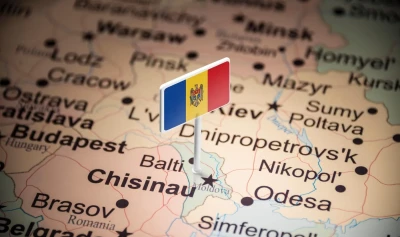


The process of the Republic of Moldova's accession to the European Union could also definitively resolve the Transnistrian issue, says the country's new ambassador to Romania, Mihai Mitu, Agerpres report.
In an interview with AGERPRES, he stated that the authorities in Chisinau will include the population on the left bank of the Dniester in EU-financed projects, so that they can feel the benefits of belonging to a European state.
The Moldovan diplomat also spoke about the key role Romania plays in the Republic of Moldova's EU accession process.
Mihai Mitu also referred to the role of Romanian investors in the Moldovan economy, noting that companies with Romanian capital provide more than 12,000 jobs on Moldovan territory.
AGERPRES: Mr. Mihai Mitu, you have taken up the office of ambassador of the Republic of Moldova in Bucharest. What does this position represent for a career diplomat such as yourself?
Mihai Mitu: First of all, I want to thank you for the invitation to sit down today (Friday, Ed. note) for an interview, particularly on such an important day, which marks the Union of Bessarabia with Romania - a historic event of major significance. On this occasion, I would like to pay tribute to all those who laid the foundations of this courageous act, to all the architects of this event, and I especially encourage the younger generation to keep alive the memory of those who made this act of great historical importance possible.
AGERPRES: As far as your mandate is concerned ...
Mihai Mitu: As for my mandate, it is a very important one, just as the relations between the Republic of Moldova and Romania are very important, and at present they have reached impressive levels. This is due to the openness of both the authorities in the Republic of Moldova and of those in Bucharest. I hold high ambitions regarding the achievements so far and those to come, strengthening these relations and the opportunities that exist on both sides of the Prut, because we are experiencing a quite active period: as a country, we are deeply engaged in the process of European integration, on the one hand, and Romania, on the other hand, is our partner and our most important supporter on this path.
AGERPRES: On a personal level, does this mandate have to conclude with an objective you have already set for yourself?
Mihai Mitu: Yes. The most important aspect is for this mandate to conclude with the Republic of Moldova's accession to the European Union, with that goal I have set myself at the national level - accession by 2030 - which would coincide exactly with the period when my term is expected to end. And if, during this term I can contribute to this goal - and here I can assure you that I will make every necessary effort and exercise all due diligence to achieve it and to support the team in the country, which is working very hard and tirelessly on this process - then we will hopefully all meet together in this great family.

AGERPRES: You have already had an initial series of meetings with Romanian officials. How would you terms these bilateral relations?
Mihai Mitu: Indeed, I had several courtesy meetings at the beginning of my term in office, and they were very good. I was welcomed with great warmth and openness. Of course, from the outset, we have outlined a series of objectives on both sides. As I said, we have a lot to do, and the time available to achieve these objectives is very short. Therefore, from the very first day, I embarked on these meetings and activities, which I very much hope will materialize and lead to the expected results.
AGERPRES: Romania plays an important role in the Republic of Moldova's process of accession to European structures.
Mihai Mitu: You are right when you speak about the role Romania plays in this process. It is a key role, and we rely on Romania's unconditional support when it comes to representing the Republic of Moldova before EU member states, because through Romania, Moldova's voice is heard. This helps us advance further in this very complex process. Recently, we obtained the opening of technical negotiations on the negotiation chapters, which will allow us to move forward faster. And here again, Romania plays a very important role, as it provides us with all the necessary support in terms of expertise and experience, something that benefits us greatly. On this occasion, I would also like to express our gratitude to Romania for this continuous support.
AGERPRES: There is a usual practice between Romania and the Republic of Moldova to periodically hold joint government meetings. Has the organization of a joint government meeting been discussed at this stage?
Mihai Mitu: Indeed, in the past we have had several meetings held both in Romania and in the Republic of Moldova. At present, a joint meeting is not on the agenda, but this does not exclude the possibility. Given how close the relations are between the authorities in Chisinau and those in Bucharest, it is very likely that such a meeting could take place in the near future.
AGERPRES: Could obstacles arise in the Republic of Moldova's EU accession process?
Mihai Mitu: I wouldn't describe them as obstacles, because the Republic of Moldova has already achieved and recorded remarkable progress regarding the recommendations set out by the European Commission, in terms of advancing negotiations and opening negotiation chapters. Therefore, what is most important is for us to do our homework, and as long as we continue to make progress along this path, I believe we will succeed in reaching the final goal.
AGERPRES: The reintegration of Transnistria into the Republic of Moldova seems to be a difficult process. Could this be a factor that delays the accession process?
Mihai Mitu: You are right when you say it is a difficult process. Above all, it is a long-term process. What we, as a state, want and advocate for is to resolve this issue peacefully and in full respect of all the regulations related to territorial integrity and national sovereignty. I do not believe we can speak of any blockages in the accession process due to the Transnistrian issue not yet being settled. I think these matters should be viewed separately. Moreover, I believe that as we advance on the European integration track, the Transnistrian issue can also be resolved, because active involvement in all EU-funded programs and projects is also directed toward the Transnistrian region, and we are trying to be as attractive as possible to the population in the region, to show them the benefits of belonging to a European state, and this could contribute positively to resolving the conflict.
AGERPRES: Could the war in Ukraine, triggered by the Russian Federation, act as an accelerator for the European integration process?
Mihai Mitu: It certainly is, because the Republic of Moldova submitted its application for EU membership four years ago, at the onset of this barbaric war in Ukraine, and clearly the speeding up of the process is also due to this factor. However, it is out of question that the Republic of Moldova could try to eschew or cut corners, to find a shortcut to fulfill all the necessary criteria for EU accession. Of course, the situation in the region comes with a series of security-related complications, and this must be addressed.
AGERPRES: And the Republic of Moldova is, in a way, a victim of these wars unfolding nearby. Hybrid warfare is extremely present in the Republic of Moldova. Are you trying to cope relying on Romania's support?
Mihai Mitu: Absolutely. At present, the Republic of Moldova has managed to withstand these ongoing attacks remarkably well. And here, of course, Romania's support has been equally important, as we have benefited from assistance in terms of expertise on cyberattacks, among other things. This is an ongoing process that takes time, and we will certainly continue to need this support, because the Republic of Moldova is in a rather complicated region as long as this war does not reach, as we can see, any conclusion - something we very much hope will happen.
AGERPRES: Is there a need for a stronger presence of Romanian investors on the Moldovan market, for stronger economic development between the two states?
Mihai Mitu: Of course. One of the priorities of my term will be strengthening our capacity to attract investment into the Republic of Moldova, because Moldova is a country with considerable potential. What we see now is that interest from Romanian companies to enter the Moldovan market is quite active, and this must intensify. Romania is currently the largest investor in the Republic of Moldova, and we have our highest volume of trade with Romania.
AGERPRES: Could Romanian investors, public or private, take over strategic sectors of the Moldovan economy?
Mihai Mitu: I am not sure we are speaking about strategic sectors. They could certainly become more actively involved in the country's economic development. At present, thanks to this economic involvement, Romanian companies investing in the Republic of Moldova contribute to job creation. I believe more than 12,000 jobs are currently provided thanks to the presence of Romanian investors in Moldova, which is impressive and, at the same time, opens new opportunities and places an additional responsibility on us to promote this destination even more.
AGERPRES: The Foreign Ministry in Chisinau has positioned itself in favour of withdrawing from the Commonwealth of Independent States. Is this a necessity or an obligation imposed by Europeans in this process?
Mihai Mitu: Indeed, the Republic of Moldova began its withdrawal from this organisation long ago. What we see now is essentially the conclusion of a process that started earlier. It is not a conditionality imposed by the European Union. Rather, it is an internal decision of the state - a deliberate one - resulting from an assessment of whether these agreements are still feasible and still serve the interests of the Republic of Moldova and its citizens. Once they no longer do, these agreements lose their usefulness. However, there are several bilateral agreements that will remain in force.
AGERPRES: New discussions on the unionist topic have emerged in the Moldovan public space. Are they still relevant?
Mihai Mitu: Everything related to the topic of unification is something that has been repeatedly brought up in the public space over time. Recently, I followed very closely how certain statements by Moldovan officials were circulated. Those remarks were made in a context referring to certain security risks. Clearly, the Republic of Moldova's actions and determination are toward European integration, and unification can occur naturally through the country's participation in - or acceptance into - the great family of the European Union.











Comentează