



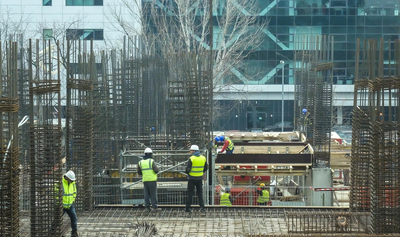


Romania's construction market is approaching a major standstill due to the economic slowdown, delays in financing, and an acute lack of predictability in the implementation of investments. Delays in political decision-making will sharply increase the socio-economic costs, warns the Romanian Association of Construction Entrepreneurs (ARACO) in a press release sent to AGERPRES on Friday.
'The construction market in Romania is approaching a major standstill due to the economic slowdown, delays in financing, and the acute lack of predictability in the execution of investments. Increasingly, projects are being suspended or postponed, payments are delayed, and activity on construction sites is visibly slowing, creating the risk of a negative knock-on effect across the national economy. In the absence of urgent and decisive measures from the Government, the construction sector - one of Romania's main growth engines (8-9% of GDP in 2025, the highest share in the EU) - risks entering a systemic gridlock, with direct negative consequences for public investments, absorption of EU funds, and tens of thousands of jobs. The surge in fuel costs caused by the Gulf War alone could trigger a new bottleneck in the construction sector (similar to those caused by the Covid pandemic and the war in Ukraine) if public beneficiaries refuse or delay contractual and legal adjustments,' the association's representatives said.
In this context, ARACO proposes the urgent adoption of a series of measures to restore financial predictability and continuity of investments, without which the construction sector risks 'grinding to a halt'.
The first measure concerns the adoption of a fiscal pact for a minimum of five years, guaranteeing stability of labour taxes, maintaining the VAT regime applicable to public works, and ensuring legislative predictability. 'Major investments in road, rail, environmental, energy, healthcare, dual-use, or critical infrastructure cannot be properly planned in a fiscal system that changes frequently,' the construction entrepreneurs argue.
At the same time, ARACO proposes the quantification and periodic payment of justified costs incurred by contractors during the suspension of public investment contracts, and the introduction of clear contractual mechanisms for managing work suspensions and compensating unavoidable costs.
Regarding unilateral contract terminations, ARACO stresses that these are a legitimate and predictable response by contractors to unjustified suspension of funding by beneficiaries, generating major bottlenecks (construction site preservation, loss of workforce, risk of devaluation of the Performance Bond, and threat of permanent loss of EU funds).


Other proposed measures include timely payment for public works, strengthening the dynamic price adjustment mechanism, a ten-year national investment programme, reform of the public procurement system, and the removal of the 'lowest price' criterion as the dominant factor in tenders.
Additionally, contractors are calling for a national construction training programme, simplification of building permits, acceleration of projects funded through the RRF (Recovery and Resilience Facility), adjustment of Performance Bond amounts to 3-5%, removal from Government Decision 375/2022 of provisions on intermediate inspection documents, and a national programme for affordable housing.



















Comentează