



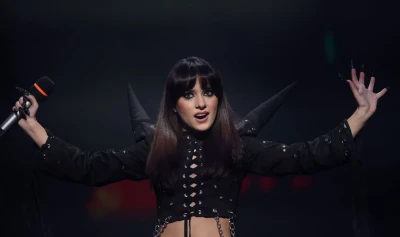


In an interview with AGERPRES, 22-year-old singer and composer Alexandra Capitanescu, Romania's representative at this year's Eurovision Song Contest with the song 'Choke Me', spoke about what participating in the European competition means to her.
"We want to get as high as possible (...) and I believe Romania deserves, after many years, a moment of glory there," the artist said.
She also explained the message behind the song she will take to Vienna and clarified the meaning of its controversial title, which "has been interpreted in many ways". For her, the song represents "a new beginning as an artist, a development, a way to put my feelings into music the way I've wanted for a very long time."
"I've read many articles (...) saying the song would be considered violent, but I don't think so - that was not the intention, and I am against violence. I believe that, as I say in the song, the only antidote for everything is love. In fact, that is the core of this song: love, fondness, and the only excess in our lives should be love," she said.
Regarding her chances in the competition, Alexandra Capitanescu "strongly" believes that the artistic moment on the Eurovision stage is what matters most. "I believe in those three minutes that can work miracles," she declared.
Here follow extensive excerpts from the interview:
AGERPRES: What inspired you, and how did the song 'Choke Me' come about?
Alexandra Capitanescu: The song came together very quickly, I would say. I went into the studio with Calin Grajdan and Majii (Elvis Silitra), two very talented composers, and Calin played us a synth line from the verse of 'Choke Me' that he had on his laptop. It inspired me immediately, I loved the sound, and we started writing based on that fragment. The idea developed from there. The song didn't sound like this at first; we originally had a different chorus. But we met again a few days later and created the chorus everyone now knows and hums. The lyrics flowed naturally, we didn't overthink them. Majii and I were very inspired that day, and 'Choke Me' was born.

AGERPRES: What is the message of the song? Beyond the artistic dimension, what do you think it conveys socially or morally?
Alexandra Capitanescu: The message is very direct. I know that at first contact - especially with such a title - people are a bit surprised, positively or negatively, and there's this curiosity about what 'Choke Me' actually means. It has been interpreted in all sorts of ways. But for me, the song represents a new beginning as an artist, a development, a way to put my feelings into music, something I've wanted for a long time. It used to be very hard for me, and even now I can't do it 100% every day, but I want my music to be like a diary, a safe place where I don't have to censor myself. In everyday life, we all know we can't always say everything we feel - if we were one hundred percent honest all the time, there would probably be global chaos. But in art, as long as we don't hurt anyone, we can express our feelings as they are.
AGERPRES: Speaking of the song's message, there have been critical reactions recently, including accusations from British activists suggesting the title and message might be "dangerous". How do you respond to these criticisms, and how do you justify this artistic choice in the context of Eurovision?
Alexandra Capitanescu: Yes, I've read many articles saying the song could be considered violent, but I don't think so, that was never the intention, and I am against violence. As I say in the song, the only antidote for everything is love, affection. That's the core of the song: love, fondness - and the only excess in our lives should be love. 'Choke Me' is a kind of excess. It means "choke me with your love" or "with my love", because in the song I'm also speaking to myself - to that part of me that overwhelms me with negative thoughts. I'm telling myself: don't choke me with negativity, with ideas that I'm not enough or not doing enough; choke me with love so I can be creative. That line - "love me, make my lungs explode" - was interpreted literally, but for me it means giving myself complete freedom to sing, to express myself. It's joy of the freedom to sing.
AGERPRES: A kind of "suffocate me with love" ...
Alexandra Capitanescu: Exactly! And there are many musical examples that use strong metaphors. The most obvious is "Killing Me Softly", right? "Killing" seems much more serious to me than 'Choke Me', because it is ...
AGERPRES: It's already a simply bad message, to call it like that.
Alexandra Capitanescu: Yes, and we have so many Romanian poets who used symbols like this in their work to express their feelings and experiences. Strong metaphors have always existed, from antiquity to today.
AGERPRES: Do you think these criticisms will affect your artistic journey before the Vienna competition and the semi-final?
Alexandra Capitanescu: I can already see that, little by little, people are turning around ... Many write to me saying "thank you for this song, I really felt what you were expressing". Someone even wrote to me that "thanks to your song, I started drawing again", which is wonderful. It makes me feel good, and I want to encourage everyone watching this interview to continue their evolution. Evolution takes time, it comes with work, perseverance, discipline. I don't want to focus on the negative aspects or on whether this will influence what happens in Vienna. I believe that what will matter in Vienna is the moment on stage - the direction, the costumes, the vocals, the overall energy. A lot will change by then, and the decisive moment will truly be the performance in Vienna. /.../
AGERPRES: Since you mentioned technology, TikTok, messages, do you think new technologies will influence the vote?
Alexandra Capitanescu: If I hadn't followed Eurovision, I would have said yes. But after watching it for so many years, and after seeing contestants online before seeing them on stage, everything changed once they performed. It didn't matter as much anymore. Yes, online activity helps, but every time, those three minutes on stage surpassed anything on social media. I firmly believe the artistic act of that evening is what counts. It doesn't matter what country you come from, it doesn't matter how many followers you have on Instagram or TikTok, I don't believe in that. I believe in those three minutes that can work miracles. /.../
AGERPRES: What message do you have for the audience who will vote at Eurovision? Why is 'Choke Me' worth voting for?
Alexandra Capitanescu: I'll speak in Romanian, because I'm mostly addressing Romanians: Dear Romanians, I know you cannot vote from Romania, but if you happen to be abroad in Europe or elsewhere and you see our moment on May 14, in the Eurovision semi-final in Vienna, and you like what you see, and you feel that Romania can be represented by the song 'Choke Me', then you can vote for us! I think it's incredibly important that Romania participates in Eurovision, that we have visibility, that we can show our country to the world. I hope we can make you proud, so that when you come home, we can raise a glass, open the champagne, and be happy that Romania reached as high as possible.
***
On the Vienna stage, Alexandra Capitanescu will be joined by Bogdan Stoican (guitar), Matei Mihail Cohal (bass), Thomas Circota (piano) and Luca Alexandru Sofron (drums).
Guitarist Bogdan Stoican hopes Romania will have a successful appearance at Eurovision.
"For me, the message of the song is about love, in a way, but at the same time it's also a fight. What's important is that each listener finds themselves in the song and discovers their own message. This is the beautiful part of it. (...) We want to be voted for, obviously, if you like the song. We like it very much. We are proud of what we've created and we'd like you to vote for us so we can take Romania to a very good position, maybe even achieve a result we've never had before, in a good way, and have a successful performance there," he said.
Matei Cohal, the band's bassist, also spoke about the song's meaning.
"The song never had a negative message. The problem is how some people chose to interpret it. It's unfortunate that it happened this way, but we've always said that everyone is free to interpret it as they wish. Still, we never intended anything negative in what we wanted to express through music - that's completely wrong. (...) People are free to do what they want. Everyone resonates with a certain music. If there are people who connect with our song, of course we want them to vote for us, but it's each person's choice," Matei Cohal said.
Keyboardist Thomas Circota emphasized the song's energy.
"The song was never about violence, it never aimed to provoke such reactions. (...) But everyone has their opinions and will believe what they want. We can't tell them otherwise, we tried, but people will believe what they believe. Until ... I don't know until when. (...) It's a song full of energy, a song that gives us courage, and I hope it gives you courage too. The show will be fantastic. So, vote for us!," was his message.
"Here's the Alexandra Capitanescu gang, see you in May in Vienna and, if you like our moment, don't forget to vote for Romania!," the five young artists said.
***
Under the slogan "United by Music", the Eurovision Song Contest 2026 will take place in Vienna, with semi-finals on May 12 and 14 and the final on May 16. In this 64th edition, 34 countries will compete alongside Romania: Albania, Armenia, Australia, Austria, Azerbaijan, Belgium, Bulgaria, Croatia, Cyprus, Czech Republic, Denmark, Estonia, Finland, France, Georgia, Germany, Greece, Israel, Italy, Latvia, Lithuania, Luxembourg, Malta, the Republic of Moldova, Montenegro, Norway, Poland, Portugal, San Marino, Serbia, Sweden, Switzerland, Ukraine and the United Kingdom.








Comentează