



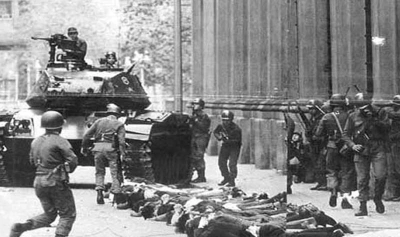


The documentary exhibition project "Revolution '89: The 36-metre band / Perspectives and Fragments", which explores the Romanian Revolution of 1989 through three distinct forms of testimony - visual, audio and performative - will be on display from 9 to 31 December at the Romanian Cultural Institute (ICR) in Budapest.
According to a press release from the ICR sent to AGERPRES on Monday, the project, whose opening will take place on Tuesday, December 9, at 19:00 at the ICR Budapest Gallery, aims to move beyond the framework of conventional commemoration, offering the public a direct immersion in the emotion of those decisive days.
The exhibition "Image. Sound. '89", curated by Madalin Marienut, functions as a visual and auditory backdrop, recreating the atmosphere: from the roar of the crowd to the oppressive silence, from iconic images to forgotten snapshots. Another segment is an act of historical recovery through the presentation of recordings by Anna Lengyel, a journalist at the Hungarian National Radio in 1989. Her voice is that of the external witness, the informed observer who conveyed to the world the pulse of events in real time.
Actor Remusz Szicksai will give a performative reading in Hungarian from the volume "A Romanian Diplomat in Budapest" by George Albut. The performance will be accompanied by the original reportage recordings of journalist Anna Lengyel.
The performative character of the project is built around the history of the place where the event is held, namely 5 Izso Street, currently the address of the ICR Budapest headquarters. In 1989, this street was home to the embassies of Romania and the Federal Republic of Germany. The journalist Anna Lengyel also lived here, reporting for months on the ordeal of East German refugees who climbed over the fence of the FRG Embassy to seek asylum and, later, on the protests in front of the Romanian Embassy against Ceausescu's dictatorship.

"During the event, the garden and building of ICR Budapest symbolically become once again a space of reclaimed freedom. The proposed project does not seek to offer definitive answers, but to open a space for essential questions: How is collective memory built, and how can we remain vigilant witnesses of the present, tuning in to the correct frequency of the lessons of the past?," the press release states.
The exhibition at the ICR Budapest headquarters brings together works by Constantin Duma - an eyewitness to the 1989 events; Andrei Pandele - architect and photographer; Gabi Stamate (1958-2020) - represented with a series of documentary photographs taken on 21 December 1989 in Bucharest (Magheru Boulevard area); works from the Mihai Zgondoiu collection; Anika Sandor - an emerging artist exploring participatory memory of communism; Carlos Permuy - Spanish photographer; Camil Mihaescu - photographer and visual artist, university professor (West University of Timisoara), specialised in alternative photographic techniques and critical interventions in historical archives; Andreea Palade-Flondor - associate professor and visual artist focused on artistic mediation and youth education in post-socialist contexts.
The project's title is a statement of intent: " the 36-metre band" refers to the echo the Revolution still has in the collective consciousness more than three decades later, as well as to the crucial role of radio waves in transmitting information and hope during an era of censorship.
Radio Free Europe used the 36-metre band for Romanian-language shortwave broadcasts during the 1980s.
















Comentează