



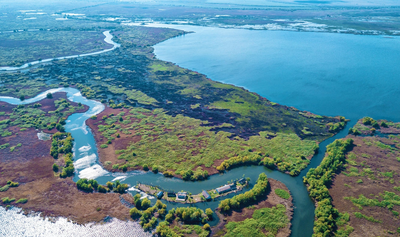


The Governor of the Danube Delta Biosphere Reserve (DBBR), Bogdan Bulete, does not agree with the resumption of hunting activities and recommends that people who want to do this compare the ecosystems of the Delta in Romania with those in Italy and Spain, recalling that the biodiversity of the reserve is one of the main assets of this area of the country.
Hunting in the BDBR was banned in 2011, after the entry into force of law no. 136 which amended the normative act on the basis of which the Reserve was established, and subsequently actions were taken in the area to extract specimens of wild boars, foxes and jackals, at the request of local communities or specialists, in the case of sanitary-veterinary problems, such as African swine fever, with the agreement of the Scientific Council of the RBDD Administration and with the opinion of the Romanian Academy.
"If we want to compare several protected areas, we could start with the Ebro Delta in Spain, the Pou Delta in Italy and the Danube Delta in Romania and see which protected natural area has a better conservation regime, which protected area is better preserved, protected from the three and then draw conclusions if we want to move towards that kind of delta or do we want a delta that offers this wealth of gene pool that now exists, over 8,000 species of plants and animals", the governor of the Reserve, Bogdan Bulete, told AGERPRES.
He recalled that the ban on hunting in the RBDD was based on scientific studies and mentioned that there is currently no research indicating the opportunity to resume this activity.
Recently present in Tulcea, the president of the General Association of Hunters and Anglers (AGVPS), Ovidiu Ionescu, pleaded for the resumption of hunting in the RBDD.
"We plead for the opening of hunting in the Delta, especially for locals, not necessarily for commercial hunting. Hunting is a traditional activity, in all biosphere reserves hunting is practiced by locals. When hunting was interrupted, many species that nested on the ground suffered, because jackals multiplied greatly, and before the African swine fever, wild boars also multiplied", the president of the AGVPS, Ovidiu Ionescu said.


According to data provided by the National Institute for Research and Development of the Danube Delta, the first jackals in the reserve were observed in 1962.
The Danube Delta is recognized by specialists as the youngest land in Europe, the alluvium brought by the river to the Black Sea forming new territories that can be observed in Sulina, the only town inside the reserve. For researchers, the Delta is a huge living laboratory, despite the fact that, over time, people have straightened the arms of the Danube so that the road between Tulcea and the localities in the reserve would be shorter, but also the intentions materialized during the communist regime to transform the area into the most important "granary" of Europe



























Comentează