



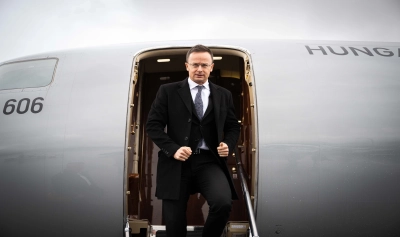


Energy supply is based on physical reality, and infrastructure determines with whom you can cooperate and where you can purchase, Hungarian Foreign Minister Peter Szijjarto said on Wednesday in Bucharest at a ministerial meeting of the Partnership for Transatlantic Energy and Climate Cooperation (P-TECC).
"I think when we speak about the safe supply of energy, we should not forget about the fact that the energy supply is being based on physical reality. So, in order to deliver gas, in order to deliver oil, you need pipelines. So, pipelines, the infrastructure, definitely does determine with whom you can cooperate, from where you can purchase. Look at the situation of Hungary, for example, when it comes to oil. We have a certain amount, what we need, to supply the country. Slovakia does need a certain amount. I put these two countries together because we are on the same line. The pipeline leading from Russia through Ukraine supplies us basically entirely. Why? Because there is no other alternative route. We would be very happy to put into consideration the diversification, but the precondition of diversification is alternative routes of supply. Now, a pipeline from Croatia is leading to the countries of ours, but the problem is that it has a very limited capacity. Two years ago, when the [Russian] oil ban was first put on the agenda of the European Union, both of us Slovaks and Hungarians we have turned to the European Commission to make it sure that Croatia increases the capacity of this pipeline so we can diversify the sources. What happened? The European Union reached out to the Croats, but it was not the capacity that was increased, because it is still the same, but the transit fee was increased five times. So, here's the problem," Szijjarto said.
He added that a second problem concerns gas supply, given that the pipeline network in the South-East European region is very limited and the European Commission will not invest in infrastructure, because that in 15 years' time natural gas will no longer be part of the energy mix.
"We are the first country which is not neighbouring Turkey, but is buying Turkish gas. And this year, first time ever, we started deliveries from Azerbaijan. Now, why we can do it in a very limited way, in a very limited quantity - which does not allow us for entire diversification - is because the pipeline network in the South-East European region, which connects us to Azerbaijan, Turkey, Qatar, is very limited. So, we have turned to the European Commission together with Slovakia, with Romania, Bulgaria, Serbia and Greece, asking the European Union to finance the increase of the capacity of the south-eastern European pipeline network in order to enable Slovakia, Hungary, Bulgaria, Romania to buy more gas from diversified sources. What was the answer of the European Commission? Sorry, guys, gas is not being sexy anymore. Gas is not going to be part of the national energy mix in 15 years, so the EU is not ready to invest into that infrastructure. So, here we are without the physical chance of diversification. And that's a problem, because it's not a political issue. If you want to buy gas or oil from different sources, you need the pipelines, you need the network, " the Hungarian official explained.
He added that nuclear energy is very important for Hungary, which can thus produce to cover consumption. At the same time, Szijjarto said that the nuclear project in Hungary is a very international one, and, although the main contractor is the Russian company Rosatom, based on a contract signed in 2014, the major subcontractors are German, French, American, Swiss and even Austrian.


High-ranking representatives of the public and private energy sectors met on Tuesday and Wednesday at the Parliament House for the fifth meeting of the P-TECC, organised by the U.S. Department of Energy, the Romanian Ministry of Energy and the Atlantic Council. Wednesday's ministerial meeting focused on the role of industrial policy in achieving transatlantic energy security and climate goals.












Comentează