



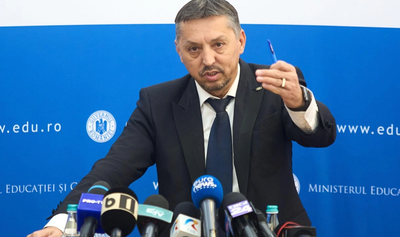


Education and Research Minister Daniel David, in his National Day message, reflects on the moment he realised the depth of interpersonal mistrust in the country and how it fuels societal divisions and polarisation, noting that no meaningful measures have been taken to address it.
"The country, defined fundamentally by its territory and language, belongs to all Romanians, regardless of where we stand amid today's divisions and polarisation. More than a decade ago, I was perhaps the first speaking as a psychologist to warn about the rise of interpersonal mistrust and the trajectory towards such polarisation. Yet no meaningful measures were taken, and we now find ourselves, antagonised, pulling apart the very social fabric that binds us, putting the entire country at risk," the minister emphasises, according to a press release sent to AGERPRES on Monday.
He notes that 2025 may be the country's most challenging year since the 1989 Revolution. The first half was marked by a major political crisis amid economic austerity, while the second half brought a fiscal-budgetary crisis that now threatens the state's ability to function.
"We have had such crises in this period before, but perhaps never so closely linked together and never in such a dangerous international context a war at the border and a redefinition of democratic institutions and the international order. That is why it is important, without cancelling the values and opinions that divide us normal things in a democracy, which protect the country, since if X fails, non-X remains to build bridges between us through respect and solidarity when it comes to Romanians and Romania. Only in this way will we be able to create a national network that protects the country in this complicated period and supports its security and development once we exit this crisis," Daniel David says.
He also notes that it is important for each of us to responsibly do our job wherever we are.
"As Minister of Education and Research, I believe Romania's future lies in becoming a knowledge-based society. My mission, therefore, is to ensure that scientific research adequately produces knowledge and that education disseminates it efficiently, so that its use brings prosperity to all Romanians. This can only be achieved today through complex, functional education and science ecosystems. An efficient education ecosystem means learner-centred approaches (students/pupils or anyone learning), with teachers (and supporting staff) as key actors, the involvement of parents (for pupils), and the support of local/national authorities and the socioeconomic environment, all aimed at co-creating life skills. A CDI ecosystem means concentrating resources on generating knowledge with theoretical and/or practical impact, where researchers, as main actors, work in partnership with education-culture, industry-economy, and society at large (including various authorities). But beyond my mission as a minister, this is also a duty to the generations that built this country, to today's generations and to those that will follow," the minister adds.

Knowledge, he stresses, is the antidote in our times to the attack of pseudoscience on civilisation and democracy, while functional illiteracy is the potentially fatal virus of a knowledge-based society.
"Simply put, functional illiteracy refers to the inadequate acquisition of key competencies or the inability to use them in everyday life, which makes us vulnerable to manipulation and conspiracy theories and affects our effective integration in society and the labour market. Therefore, depending on its operationalisation, Education-Research (Science) can make a society prosper or keep it in underdevelopment, sometimes even collapse into obscurantism. In essence, integrating Education and Research (Science) is fundamental if we are to develop as a knowledge-based society: (1) without research, we become a scientific/technological colony, and (2) without education, we become a civilisation collapsing into obscurantism!" reads the release.
He recalled that functional illiteracy is a national security risk and that he focused a large part of his ministerial resources on addressing this risk, both directly (through reforms targeting it e.g., remedial learning, reducing school dropout) and indirectly (through reforms strengthening the alternative e.g., curriculum reform aimed at improving education quality, critical thinking, modern learning methods).
"I appreciate that this vision has been included in the National Defence Strategy for 2025-2030, and it is now the patriotic duty of all of us to implement it properly. It must be stated clearly that National Day belongs to all Romanians, wherever they are, and I am glad that I had the chance to convey a similar message directly to those in the United States, on the occasion of the event organised by Romania's Embassy in the US. I believe patriotism does not mean isolation, but taking Romanian identity to the most important parts of the world, as happened in the US, where the National Day of our country was honoured by hundreds of participants, many of them Americans. Through such gestures respect and solidarity among Romanians and responsibility in what we do this is how I believe patriotism should be expressed. And what better context to encourage this than Romania's National Day! Happy National Day to Romanians everywhere! Happy National Day, Romania!" Education Minister Daniel David added.






















Comentează