



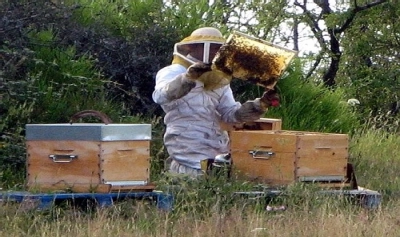


Romanian beekeepers are asking for urgent measures to support bee families and reduce production costs amid the economic difficulties of recent years, warning that honey imports from Mercosur states will put additional pressure.
Chairman of the Association of Romania's Beekeepers (ACA), Razvan Coman, says that, although last year there was an unsuccessful attempt to get a de minimis aid from the Ministry of Agriculture to support bee families, there are currently four legislative projects in Parliament aimed at providing financial support for each bee family, reducing VAT on food used in apiaries and reducing some tax costs that affect the beekeeping business, agerpres reports.
"We tried, at the ministry level, to get funds at least for the preservation of bee families by providing food, but, unfortunately, support did not materialise. We had openness from some representatives in Parliament, and at the moment there are four bills under discussion. Two of them provide support for each bee family for three years. The proposal aims at about EUR 12-15 for each family of bees, around RON 60-70, but the final form of the bill is not yet established. We would ask those in a position to bend their heart and soul a little towards these things, despite the economic conditions we have," Coman told AGERPRES at the National Honey Fair.
Another bill mentioned by the ACA official refers to cutting VAT on bee feed. "For most animals, food has 11% VAT, but the bee does not consume feed, just sugar, and sugar is taxed at 21%. It is practically the only food substitute we can use. Also, after the tax changes in December, taxes on beekeeping means of transport also increased, some reaching RON 2,000-3,000 per year, costs that are reflected in the prices for the final product," he said.
Regarding honey imports from Mercosur states, the beekeepers' representative warned that they could increase significantly with the elimination of customs duties. According to him, so far, about 45,000 tonnes of honey entered the European Union from the countries in that region, but the volumes could be much higher in the future, being exempt from customs duties.
"You realise that larger quantities will come and be exempt from import tax. Not only beekeepers in Romania, but all beekeepers in the European Union will definitely be affected. That does not benefit the European agricultural sector, which will also be affected in terms of pollination, because the number of bee families will decrease. The beekeepers will no longer be able to economically support a significant number of bee families or at least the existing ones, because it is no longer profitable. Basically, they go bankrupt. And all these imports from Mercosur will overlap those from Ukraine and China," Coman said.


He believes that the authorities must carry out analyses for all batches of honey that come from these countries and not just for a certain percentage. "If the analyses are done as they have been done so far, agriculture - not only beekeeping in the European Union - will have no chance. The proposal is that for each batch analysis bulletins should be made, in laboratories certified by the Union and supervised by the national veterinary health authorities, not just for 4% of the batches, as is the current situation. It is one thing to practice large-scale farming, animal husbandry or beekeeping in Ukraine, China, Argentina or Brazil and something else in the EU."
As for honey production in 2026, the ACA official says that the estimates are positive, as a production of 17,000-18,000 tonnes is being expected, much better than last year, due to the current weather conditions. The swarms of bee families in Romania have been largely rebuilt after the massive losses of last year, being now estimated at 1.5-1.6 million families.
"After an extremely difficult year in 2025, winter was almost normal and the hives that wintered in most of the country came out properly, but there are areas, especially in the central parts of the country, where mortalities were exaggerated, similar to last year. In principle, however, we can say that in most of the country spring is normal for the development of bee families, and our estimates are positive for both swarms and production. We are approaching 20,000 tonnes in a normal year," said the beekeepers' representative.
He added that the lower temperatures during this period slow down the development of vegetation, which can protect crops from possible late frosts and favour the main harvests. "We hope that this year we will have rapeseed and acacia harvests. The current climatological manifestations have favourable trends for these two main harvests," he added.
According to the official, in 2025, at the beginning of February, about 1.5 million bee families were estimated, but by the end of winter another 200,000-300,000 families were lost, so the remaining population was about 1.2-1.3 million families. In many cases, beekeepers have partially or totally rebuilt their apiaries, but economic pressure has led some, especially young ones, to give up their business.
"Most of the experienced beekeepers have rebuilt their apiaries for the most part. While 100% recovery has not been reached, then somewhere around 75-80%. Unfortunately, due to economic conditions, since 2022, many beekeepers, especially young people, have given up, because you can't sell a jar for RON 10 when you spent RON 11 on it. From an economic point of view,business is no longer profitable. Those who preserve it do this out of passion and love for bees, because, as we say, we have the bee in our blood. The bee cannot be kept like any other animal, which you feed and get something from it. It has permanent contact with nature and must be taken care of."
In addition to the economic difficulties, the ACA representative says that climate change is a major challenge, forcing beekeepers to adapt quickly.
"The conditions of five or ten years ago are no longer valid. Beekeeping requires extremely high adaptability, and beekeepers need to intervene quickly and apply methods they haven't even heard of before. Climate change has come too urgently, and research takes two to three years to get results. In the absence of harvesting, high temperatures or moving the hives to areas with more resources, all these methods must be implemented immediately. Yesterday was the best," he added.
The head of the ACA also points out that the low honey production in the previous year influenced prices, but increases were minimal, as they depend on the international market. "For example, the production of acacia honey in Romania was only 10-20% of what was supposed to be produced, but prices did not increase significantly. The European Union imports a lot of honey, and the international price practically dictates the price in Romania as well. Here lies a paradox: there is no production, but there is demand, and prices don't rise, considering that honey comes from outside, and EFSA demonstrated in 2023 that over 60% of the more than 300 samples were sugar surrogates," said Coman.
Bucharesters are invited at the spring edition of the National Honey Fair, which takes place this weekend at the Institute for Research and Development for Beekeeping in Baneasa, where over a hundred exhibitors - beekeepers and specialist companies - display their products.
Honey prices vary between RON 20 and RON 50, depending on weight and assortment.





























Comentează