



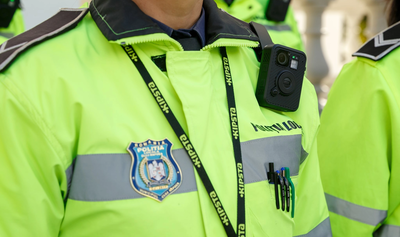


Local police officers will be able to wear and use, while performing their duties, portable audio-video recording devices such as Bodycams, according to a legislative proposal submitted to the Senate.
The project, initiated by 30 PNL parliamentarians, complements in this respect Law No. 155/2010 on local police.
The normative act provides for the creation of an express and adequate legal framework for the use of portable audio-video cameras of the Bodycam type by local police, "in order to streamline its activities and protect both citizens and local police officers," the initiators state in the explanatory memorandum.
According to the draft, "local police officers may make audio-video recordings and take photographs with the technical means provided, regarding actions carried out in public space, in the exercise of their duties, without the consent of the persons concerned, for the purpose of preventing and combating illegal acts, maintaining public order and protecting their own interventions, under the conditions of this law".
"The local police are authorized to make audio-video recordings or photographs, with the means at their disposal, regarding actions or events taking place in public places, without the consent of the persons concerned, when there are probable grounds to suspect the preparation or commission of crimes or other illegal acts or a possible disturbance of public order and safety," the normative act also stipulates.
Also, personal data obtained through photo, audio or video recordings are processed exclusively for the purposes of maintaining public order, preventing and combating illegal acts or investigating crimes - in compliance with the provisions of Law No. 363/2018 and Regulation (EU) 2016/679.


It is prohibited to use these data for purposes other than those for which they were collected, except in situations expressly provided for by law and only under the condition of implementing the necessary guarantees to protect the rights of the data subjects.
The normative act also stipulates that the local police officer has the obligation to activate the portable audio-video device Bodycam and to record audio-video the intervention in situations of legitimizing and establishing the identity of a person, of leading a person to the local police headquarters or another competent authority, during any intervention involving the use of physical force, means of coercion or materials in the equipment, such as handcuffs, batons or irritant-tear sprays, during the detection of a crime or contravention and the application of appropriate sanctions or legal measures.
Also, police officers will have to activate the Bodycam during any action or intervention carried out in public space, where there is a risk of disturbing public order and safety or of the emergence of violent situations.
"The local police officer is also obliged, to the extent that circumstances allow, to inform the person concerned that he or she is being audio-video recorded or that he or she is about to be photographed. The local police institution also informs the public that it uses portable recording devices, including by displaying visible signs on the uniforms or equipment of the police officers and by publishing relevant information," the draft also states.
Audio-video recordings will be kept for a maximum of 6 months from the date of production, except in the case where they are the subject of a judicial or disciplinary procedure.
The regulatory act also prohibits the personal use of these recordings made by the local police using portable audio-video cameras, Bodycam, and those collected cannot be made public, distributed or made available to unauthorized persons.
At the same time, access to these records will be allowed only to authorized persons, under the conditions of the law, and exclusively for the purposes provided for by this law.
"Any unauthorized access or unauthorized disclosure of these records to third parties is strictly prohibited. The deletion or destruction of records is carried out in compliance with the deadlines and procedures established by law, each such operation being recorded in a special register, to ensure the possibility of audit and control," the regulatory act also states.
Within 90 days of the law's entry into force, the implementing rules will be developed. Within a maximum of 12 months of the law's entry into force, each local public authority can develop a plan for implementing the Bodycam system, equip it and make it operational.
The project will be debated in the Senate, with the Chamber of Deputies being the decision-making body.

























Comentează