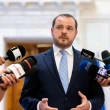
Researcher Calin Ur, director of the Extreme Light Infrastructure - Nuclear Physics (ELI-NP) project, known as the Magurele laser facility, told AGERPRES on Wednesday that the research centre is now operational but has been built for the next generation, making it essential to attract more bright, passionate young people interested in pursuing careers at the institute.
Calin Ur is attending the third edition of the international Romania-China Bilateral Academic Forum on Wednesday at Politehnica University Timisoara. Held under the theme "Physics in Use - Toward a Shared Digital Future", the forum highlights the role of fundamental and applied research in developing the technologies of the future.
"We are trying to use high-power lasers to accelerate carbon ions and open up the possibility of making such treatments accessible to the public. Another area focuses on X-ray imaging using high-power lasers - a new, much more sensitive imaging method that makes it possible to reduce the radiation doses patients receive during imaging procedures. Another very important area is the production of radioisotopes for medical use, which are employed in PET imaging," the ELI-NP director explained.
Professor Calin Ur is also focusing on training a new generation of researchers at the Magurele institute, seeking to recruit them from universities across Romania.
"Our research centre is now operational, but it has been built for the next generation. We are looking for the next generation of researchers, those who will take over from us and carry forward the research we have started at our centre. In this context, our relationship with universities is very strong. We are looking for physics students. Our aim is to attract young students to these very important fields - physics, nuclear physics and laser physics, but not only these. We are also looking for engineering students, because research today is interdisciplinary. We currently have 70 students at doctoral, master's and undergraduate levels, but we would like to have more, because that would secure our future and long-term prospects. This is our role: to offer young people an alternative. Our research centre is among the world's leading facilities and offers the same working conditions as any comparable centre abroad. Young people now have an opportunity here that many of us had to go abroad to find in order to build a career," the ELI-NP researcher explained.
Calin Ur also stressed that ELI-NP has very strong ties with China, with the two sides jointly developing technologies in high-power optics and methods for operating high-power lasers. He added that cooperation in nuclear physics is also very good and has developed over time.
Meanwhile, in the context of the forum's theme, Professor Radu Precup of Politehnica University Timisoara (UPT) said Romania is at least ten years behind China in urban mobility, an area in which the university is conducting several joint research projects with Chinese partners.


He explained that rapid technological advances in urban mobility infrastructure could eventually make bus drivers obsolete, just as the occupations of cart drivers and coachmen have disappeared.
"We launched a Chinese-European project in 2023 focusing on urban transport. In both Europe and China, urban transport is well developed in central areas of cities, but we must not forget those living in outlying neighbourhoods. We are working on electric transport at several levels, all of which need to be properly interconnected to ensure mobility, while keeping energy consumption relatively low, which is quite a complicated task. We are working with electric buses and autonomous electric buses. In fact, we expect the occupation of bus driver to disappear in the coming years, just as those of cart driver and coachman have disappeared," the academic said.
Romanian Academy President Professor Marius Andruh explained that the event already has a substantial history, having been launched in 2024 to mark the 75th anniversary of diplomatic relations between China and Romania.
"We created an event featuring scientific presentations from both sides. To get to know each other better, we had a presentation from our side on information science and technology, followed by cultural aspects presented by the Academy's Folklore Institute. (...) This year, the theme is physics for a digital future. (...) We can learn from everyone; every interaction is useful, in both directions," the Romanian Academy president emphasised.
Chen Feng, Ambassador Extraordinary and Plenipotentiary of the People's Republic of China to Romania, highlighted China's rise to tenth place this year in the World Intellectual Property Organization's (WIPO) Global Innovation Index.
"Funding for basic research has reached 283 billion renminbi (RMB, China's national currency), making it the second highest in the world. China's research and development workforce has reached 7.95 million, the largest in the world. The event in Timisoara is giving fresh impetus to academic exchanges, representing not only a practical way for the Chinese and Romanian scientific communities to carry forward their traditions, but also a tangible demonstration of the continued deepening of bilateral relations," the Chinese ambassador to Bucharest said.