



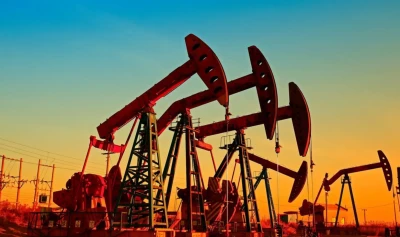


Romania does not appear to lack strategic reserves of petroleum products, but the problem is that a large portion of these stocks is located outside the country, and their real effectiveness in a severe crisis depends on accessibility, transport, authorisations, and institutional coordination, warns the president of the Intelligent Energy Association (AEI), Dumitru Chisalita.
'Almost two weeks after the onset of what is probably the largest global oil crisis, due to a slip' in a document, we find out that strategic petroleum reserves actually exist, but they are not in the country, they are only on paper, and now we intend to check whether they exist. We do not know the exact stock levels, but we want to declare a petroleum state of emergency, to use the reserves! But if there are no quantity issues, then why declare a state of emergency? One element that has caused confusion is the idea that declaring a petroleum state of emergency would be necessary to cap diesel prices or reduce excise duties. (...) However, Romania does not seem to lack strategic reserves; the problem is that the current model allows for significant structural vulnerability, because a large portion of these stocks is located outside the country, and their real effectiveness in a severe crisis depends on accessibility, transport, authorisations, and institutional coordination,' Chisalita explained in a press release Sent to AGERPRES on Monday.
According to the expert, capping prices or reducing excise duties does not require a state of emergency, as under Romanian law the state can intervene in prices through ordinary legislative instruments.
Such instruments include: government emergency ordinances, laws adopted by Parliament, or temporary regulations concerning commercial margins or compensation schemes.
'These mechanisms are standard economic policy instruments and do not imply the activation of an exceptional legal regime,' Dumitru Chisalita believes.
AEI's analysis shows that domestic stocks in Romania amount to around 1.15-1.16 million tonnes of oil equivalent, while those outside the country total 0.87-0.88 million tonnes of oil equivalent.
'The legitimate question is: why would a state with significant petroleum infrastructure allow almost half of its strategic reserves to be held abroad? Storing stocks outside the country may be cheaper or more easily available contractually than using internal capacities. The EU system was designed for an integrated market and solidarity, not for national energy autarky. The directive allows the mobility of stocks within the EU. The fact that Romania has refineries, terminals, and a network does not automatically mean that it has, at reasonable cost and immediately available, sufficient separate strategic storage capacity, plus all the logistical and financial conditions,' Chisalita explains.


He added that the law, in its current form, designates the National Administration of State Reserves and Special Issues as the central storage entity in Romania on behalf of the Romanian state. Its role is to acquire, establish, maintain, and sell petroleum stocks for special situations.
'The law explicitly states that no delegation modifies the obligation of the Romanian state to maintain reserves at the minimum level. Therefore, the ultimate system responsibility rests with the Romanian state, not just private companies. The law clearly suggests that ownership may belong to the obliged entity or the delegated entity. This confirms that legally, the reserves are not automatically state property' simply because they are strategic. In many cases, they are assets of economic operators or of the entity holding them on behalf of the obliged party,' the release notes.
According to AEI, statements such as 'there are over 2 million tonnes' followed by the notion that 'checks need to be carried out' fuel the perception that the state does not have sufficiently convincing operational control, and the system seems designed to meet the legal minimum standard rather than maximise national energy autonomy.






















Comentează