

A team of American experts, involved in the "Two Frontiers" research project, is currently working in the Buzau Land UNESCO Global Geopark, where they study how microorganisms survive in extreme environments, such as methane emanations, sulfurous odors, oil seeps, and salt springs, facing conditions as unfavourable as those found on other planets.
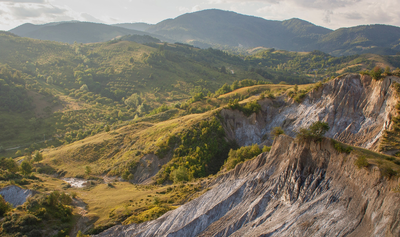
Representatives of the geopark indicate that certain areas rich in methane emanations, sulfurous odors, oil seeps and salt springs have attracted the attention of researchers who, at the end of the studies, could come up with climate solutions and possible scenarios about life in space.
"The long-term objective of the project is to contribute with solutions for the climate crisis, by studying microorganisms that can capture methane and carbon dioxide, but also to support research on sustaining life in environments other than Earth," representatives of the Buzau Region UNESCO Geopark said in a press release on Thursday.
The team that traveled to Romania is made up of four researchers and a documentary photographer, and their field work will include sampling from the Vulcanii Noroiosi/Mud Volcanoes area, the Slanic Valley and around the Colti locality.
Subsequently, the analyses will be centralised in a mobile laboratory.
"Microbes have an extraordinary ability to transform the environment they live in to survive. We find them in the most inhospitable places, from extremely cold or high-pressure environments to areas with very high salinity, where they manage to use compounds that we would consider unusable or even toxic, to sustain their lives. In this way, microbes are constantly rewriting the rules of survival. Few places on Earth offer such a great diversity of natural environments as the geopark in Buzau. It is truly remarkable: in a single area you find mud volcanoes emitting methane, mineral-rich springs, natural oil springs and ecosystems with extreme salinity. I am convinced that these sites hide unique and fascinating forms of microbial life," explains Braden Tierney, microbiologist and executive director of the "Two Frontiers" Project.
According to the geopark manager, Razvan-Gabriel Popa, the discoveries of the research team could have a significant impact on the field of science.
"This collaboration confirms the exceptional scientific value of the UNESCO Geopark Sinutul Buzaului, which is becoming a landmark on the research map. We are glad that the specialists from 'Two Frontiers' have chosen to work here, in a territory that offers rare and relevant natural conditions for international research. The Geopark team is always in contact with researchers from various fields, such as geology and biology, who have been coming to us in increasing numbers since the Geopark gained international notoriety. We are convinced that the unique elements of the Buzaului Region will successfully contribute to discoveries with a global impact," Popa said.