



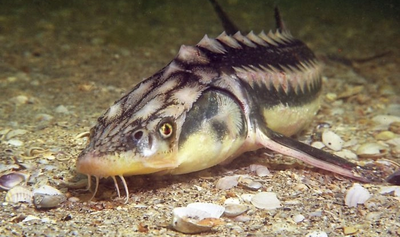


The European Commission on Wednesday approved the addition of "Batog de sturion" from Romania to its register of Protected Geographical indications (PGI).
Batog de sturion from Romania is a food made from back fillet of sturgeons from aquaculture. Such sturgeons possess desirable characteristics, as their diet resembles to that of wild sturgeons, while living in conditions favourable for growth and reproduction in a controlled, contaminant-free environment. Filleted, skinned, and portioned by hand, the fillet has a compact structure for easy slicing.
The manufacturing process of sturgeon batog includes salting with a mixture of rock salt and sugar, drying to achieve consistency with a residual moisture of at least 35% and smoking with hardwood to enhance flavour and colour. The sweet-salty taste is accompanied by a fleshy taste specific to the sturgeon species.
According to the Ministry of Agriculture (MADP), a Protected Geographical Indication (PGI) shows the link between the specific geographical region and the name of the product, where a certain quality, reputation or other characteristic can be attributed essentially to its geographical origin. In order to benefit from this quality label, at least one of the stages of production, processing or preparation must take place in the region.
The geographical area of Batog de sturion' is the area of Tulcea County, in accordance with Romania's administrative structure. This includes the Danube Delta (which occupies 87,73 % of the area of Tulcea County, about 580 000 ha) and the mouth of the Danube, which flows into the Black Sea.
Sustainability is determined by the fact that since 2006, Romania has protected sturgeons through a regime prohibiting their fishing in natural habitats, including those in the geographical area. Batog the sturion PGI contributes to the protection of natural resources, by using sturgeons from aquaculture as raw material.

Aquaculture sturgeon possesses the properties necessary for the product's organoleptic characteristics, as their diet is close to that of wild sturgeon. They also live in similar conditions conducive to growth and reproduction, and are reared in a controlled aquatic environment, without contaminants from the natural environment.
The application for registration of the product "Batog de sturion PGI is based on its reputation thanks to its sensory profile and complex aroma obtained from the traditional processing procedure, its refined taste similar to that of poultry meat, its uniform appearance, and its delicate but firm texture, characteristic of the dorsal muscle of the sturgeon.
According to Romania's Ministry of Agriculture and Rural Development (MADR), Batog de sturion' gained public attention as a quality product in September 2022 at the Rowmania-Ivan Patzaichin FEST multi-annual festival, which is dedicated to the sustainable development of the geographical area, thanks to an award bestowed on the RO-PESCADOR Association.
The application for registration in order to acquire the PGI protection for the name "Sturgeon Batog" was submitted to the Ministry of Agriculture and Rural Development (MADR) by the applicant group "RO-PESCADOR" Association from Tulcea, Tulcea County.
Romania had 15 products registered at European level, of which 12 with Protected Geographical Indication (PGI): the Topoloveni plum jam, Salami from Sibiu, Smoked bighead carp from the European Barsa region, Smoked Pontic shad from the Danube Delta, Telemea cheese from Sibiu, Sausages from Plescoi, Cheese from Saveni, Tulcea pike roe spread, Dobrogean pie, Pita de Pecica bread, Salinate de Turda salted and cured pork meat products, and hand minced meat sausage from Valcea; one with Protected Designation of Origin (PDO), respectively Telemea cheese de Ibanesti and two with Traditional Specialty Guaranteed (TSG) - traditional carp roe and marinated sardines ding to the tradition in Romania.
Currently, there are 13 Romanian products undergoing verification by the European Commission: 4 for registration as a Protected Geographical Indication (PGI) and 9 for registration as a Traditional Specialty Guaranteed (TSG).
Among the products identified for a possible registration at European level are: Telemea cheese from Vaideeni, Kneaded cheese from Bran, Rhubarb jam, Gulianca cheese, Virsli de Hunedoara sausages, Salami from Nadlac, Garlic from Copalau, onion from Pericei, Transylvanian ham, Cabbage from Toboliu, Neamt beer, smoked trout from Valea Putnei, Muscel pretzel, Smoked plums from Samburesti, Oltenian sausages, Voinesti apples.

























Comentează