



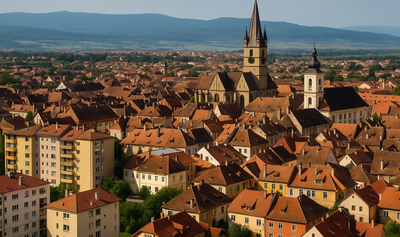


The city of Brasov, a partner in the European CARMINE project aimed at increasing cities' resilience to climate change and funded by the European Commission, is hosting these days the General Assembly of the project's 32 partners from 11 countries.
Project activities are based on eight case studies from as many European metropolitan areas - Brasov, Prague, Leipzig, Funen-Odense, Athens, Barcelona, Bologna and Birmingham - each with different socio-economic profiles and climate vulnerabilities. The meeting in Brasov focuses on assessing the exposure, sensitivity and adaptive capacity of the Brasov metropolitan region to the effects of climate change, with a particular focus on water shortage risks.
"We analyse the evolution of water resources over several time horizons: 2030, 2035 and 2050. Based on these analyses, we are developing a set of tools to be made available to the Brasov City Hall, a partner in this project, to support more efficient territorial planning. Our approach is systemic: we analyse the entire metropolitan area as a whole, without focusing on specific locations. In our analysis we concentrated mainly on periods of water deficit and drought episodes. However, there are also areas where problems related to excess water may occur, for example in lower areas of the Brasov Depression such as Schei or Prejmer. In such cases, we analyse possible adaptation measures, including nature-based solutions such as temporary dams or planting vegetation that can better absorb water and reduce its concentration along certain valleys," explained climatologist Sorin Cheval, a researcher at the National Meteorological Administration, the institution coordinating the project.
To help metropolitan communities become more resilient to climate change, the project uses Digital Twins - digital replicas of the real environment - through which scenarios and climate adaptation solutions can be tested. It also relies on advanced climate modelling technologies and spatial analyses to develop decision-support tools, risk maps and 3D models for climate analysis at the urban level.
"I am convinced that the analyses will generate valuable conclusions and beneficial solutions both for the city and the community. At this stage, we are contributing by centralising and providing the necessary data and information - from databases to the location of the various elements analysed in the project - and together with the specialists involved we will participate in interpreting the results and formulating the conclusions," said Laszlo Barabas, public administrator within the Brasov City Hall.


The project's results will contribute to the development of climate change adaptation strategies, offering examples of good practices that can be replicated in other European regions, and some of the information generated will also be accessible to the public.
The project "Climate-Resilient Development Solutions in Europe's Metropolitan Regions (CARMINE)" is funded entirely through non-reimbursable financing from the European Commission under the Horizon programme.
























Comentează