



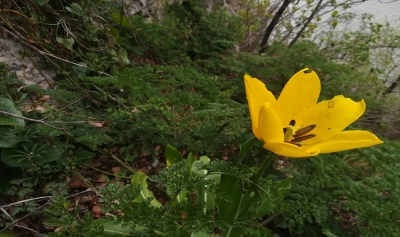


The Crang Forest in Buzau represents an important biodiversity refuge in south-eastern Romania, preserving both mature forest structures and rare plant species of high conservation value, particularly the endangered Southern wild tulip, according to the conclusions of a study conducted by the Bucharest Biology Institute (IBB) of the Romanian Academy.
Buzau City Hall requested that the Bucharest Biology Institute prepare a substantiating scientific study of the Crang Forest, a remnant of the Vlasia Forests, in order to identify valuable species in the area that could become the focus of conservation measures. The request followed a series of controversial decisions concerning the Crang Forest that were challenged in court.
In 2023, a decision of the Buzau County Council removed the Crang Forest from the list of protected areas and revised the list of protected natural monuments, thereby excluding the grove tulip on the grounds that it was not included in the IUCN Red List.
In 2005, the Ploiesti Court of Appeal reinstated the Crang Forest's status as a protected natural reserve, rejecting the County Council's appeal by final ruling.
Also in 2025, the study concerning the transformation of the Crang Forest into a park forest, approved by a decision of the Buzau Municipal Local Council, was definitively annulled by the Ploiesti Court of Appeal.
According to the Biology Institute, the argument that a natural area may only be protected if it includes species listed in the IUCN Red List is erroneous, as that document is not a mandatory legal instrument for the designation of protected natural areas at national level. Species that do not appear on the list may nonetheless have a much more precarious conservation status at national or local level. Romanian legislation does not condition site protection on the presence of IUCN-listed species, but on the existence of natural heritage elements, including rarity and scarcity.


"Dianthus guttatus is a perennial species belonging to the Caryophyllaceae family. In Romania it is regarded as a rare species. In the Crang Forest, it was identified in four observation points. From a conservation perspective, the species is classified as vulnerable [Oltean et al., 1994] and as endangered [Dihoru & Dihoru, 1994]. Klasea bulgarica (syn. Serratula bulgarica, S. caput-najae) is a rare species from the Asteraceae family and represents a floristic element of high conservation value. It has an extremely limited distribution, occurring only at a few sites south and south-east of the Carpathian Bend. According to Dihoru and Negrean (2009), the species is known from a limited number of localities in Buzau and Galati counties. From a conservation standpoint, Klasea bulgarica is included in the Red Lists of Romania's vascular flora and is considered vulnerable in the assessments of Dihoru & Negrean (2009), Oltean et al. (1994) and Dihoru & Dihoru (1994). Due to its rarity and vulnerability, the species has been included in in vitro conservation programmes [Manole et al., 2013; Ionita & Tofan-Dorofeev, 2025] and in ex situ cultivation initiatives, and is currently grown at the Dimitrie Brandza Botanical Garden of the University of Bucharest," the study sent to AGERPRES by the IBB states.
Researchers also point out that the bald cypress (Taxodium distichum) present in the Crang Forest, although not native and considered an exotic species in Romania's flora, is significant for its landscaping value and high ornamental potential, constituting a tree species of cultural and aesthetic importance for the area.
A particularly important section of the study addresses the presence of the forest tulip (Tulipa sylvestris subsp. australis) in the Crang Forest.
"Tulipa sylvestris subsp. australis is a taxon rarely encountered in Romania's spontaneous flora. (...) The population size of Tulipa sylvestris subsp. australis in the Crang Forest is estimated at between 500,000 and 800,000 individuals. This estimate should be interpreted as an approximate range. (...) Even under these conditions, the data indicate the existence of a very large local population, which confers upon the species an important role in defining the floristic and conservation value of the site.
The species Tulipa sylvestris subsp. australis is considered vulnerable in two of Romania's Red Lists of flora: Oltean et al. (1994) and Dihoru & Dihoru (1994). This means that the species is classified as being at risk of becoming threatened with extinction if the factors contributing to its decline are not mitigated. (...) In the case of this species, which has a fragmented distribution and small-sized populations, uncontrolled human intervention and changes in land use may lead to a drastic decrease in the number of individuals and to the alteration of habitat conditions necessary for maintaining viable populations. Although T. sylvestris subsp. australis is not included in the global IUCN Red List (which focuses on assessments at global scale), its status at national level is well documented in Romania's local Red Lists," the researchers who prepared the study emphasise.
In addition, the substantiating study carried out by the IBB of the Romanian Academy presents the Crang Forest as an important refuge for centuries-old pedunculate oak trees, whose age estimated on the basis of the diameter-growth ring relationship ranges between 45 and 285 years, with an average value of approximately 150 years, bearing witness to the former forest structure of the Vlasia Woodlands.
"The Crang Forest represents an important biodiversity refuge in south-eastern Romania, preserving both mature forest structures and rare floristic elements of high conservation value. Rare or vulnerable species have been identified, such as Tulipa sylvestris subsp. australis, Klasea bulgarica, Dianthus guttatus, Chaerophyllum nodosum and Fraxinus pallisiae, confirming the conservation importance of the area and the need for continuous monitoring of their populations. (...) Old and centuries-old oak trees form a core element of the Crang Forest's natural heritage, especially those preserved in the park area, contributing significantly to the forest's ecological, landscape and symbolic value. (...) Pressures on the ecosystem are significant, including climate change (prolonged drought), declining groundwater levels, habitat fragmentation, waste, the presence of invasive species and intense recreational pressure. (...) The implementation of conservation measures is required, such as limiting habitat fragmentation, protecting mature trees even when they are in decline, controlling invasive species, proper waste management and strict monitoring of rare species and sensitive habitats. The Grove Forest remains an ecosystem of major conservation interest, with high potential for sustainable management, environmental education and the responsible valorisation of its biodiversity," the final conclusions of the study under the chapter "Flora and Vegetation" state.
In the study's summary, IBB specialists note that the forest tulip represents an emblematic element of the Crang Forest, alongside other rare or vulnerable species such as Klasea bulgarica, Dianthus guttatus, Chaerophyllum nodosum and Fraxinus pallisiae, confirming the area's conservation importance and the need for ongoing monitoring.
"This synthesis explicitly mentions the identification of rare or vulnerable species, including Tulipa sylvestris subsp. australis, alongside other valuable floristic elements, while the confirmation of habitat 91I0* is presented as a major argument for maintaining and strengthening protection. The conclusions indicate that habitat 91I0* is rare at national level, fragmented and limited to a few hundred hectares, which further increases the importance of the Crang Forest as a representative site. Regarding the overall interpretation of the ecosystem's condition, the study highlights that the Grove Forest is under the cumulative pressure of climatic factors (drought, thermal stress and atmospheric water stress) and anthropogenic factors (urbanisation, the presence of domestic animals and the spread of ruderal species). (...) In conclusion, the report scientifically substantiates the importance of the Crang Forest as a natural objective of regional and national interest, justifying the need for conservation measures based on monitoring, the protection of key habitats, the preservation of mature and centuries-old trees and the limitation of anthropogenic pressures affecting ecosystem functioning," the document states.
The substantiating study for the Crang Forest carried out by the IBB of the Romanian Academy includes extensive data on climatic aspects, flora and vegetation, fauna, threats and recommendations aimed at protecting certain species.



























Comentează