



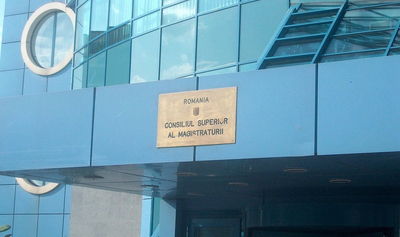


The Superior Council of Magistracy (CSM) argues that the Recorder documentary represents an amplification of a "campaign to destabilise the judicial power" and that it shall analyse "the necessary measures to be taken."
"The Council takes note of the amplification of a campaign to destabilise the judicial power by undermining trust in the justice system and in officials holding leadership positions, who have consistently taken public stances in favour of judges' independence, an essential condition for protecting the citizens' rights and freedoms. The Council cannot ignore the chronological sequence of events, previously highlighted in public statements, which followed a well-established plan involving the erosion of confidence in the justice system through the trivialisation of discussions about judges' pensions and salaries, the organisation of protests against the manner in which judges enforce the law, public calls for revolt by the country's president, the mobilisation of former retired magistrates urging the same, culminating with the journalistic report released on the eve of the Constitutional Court's ruling," the CSM's Judges Section said in a press release.
The CSM also states that the "allegations" in the documentary contradict the assessments made in recent years by the justice system, through the European Commission lifting the Cooperation and Verification Mechanism (CVM), followed by the Rule of Law reports (2023, 2024 and 2025), the accession to the Schengen area and the Organisation for Economic Co-operation and Development (OECD) accession process, all of which assuming the existence of a functional rule of law state.
"The Council underscores that the secondments/delegations mechanism cannot be enforced without the explicit consent of judges, as an expression of the principle of irremovability, making it paradoxical that this measure is criticised precisely by those who, at the time, gave their consent. Furthermore, the formation of judicial panels is not determined solely by the will of the court president, but follows a procedure involving the proposal of the section president, the management board and subsequently the president's decision, and the final act can be challenged by any person, including by the judge who considers themselves prejudiced by the change in the panel to which they belong. The same applies to the rejection of transfer requests, with decisions in this matter being subject to appeal to the High Court of Cassation and Justice, whose case law is available on its website," the CSM said.
According to the CSM, the current regulations provide sufficient judicial oversight "in relation to the so-called disclosures made in the report."
The Council announced that it is analysing the measures to be taken and called on society "not to be influenced by isolated positions."
"The anathema cast over the entire body of judges based on allegations, based on using selectively chosen criminal cases, even though criminal cases represent only 10 percent of the total caseload, is likely to destabilise the judicial power, with serious consequences ultimately for the citizens' fundamental rights and freedoms. The Council will review and analyse the necessary measures to be taken, however, at the same time, it assures the judiciary that it remains faithful to its constitutional mission of guaranteeing judicial independence, regardless of the pressures to which it is or may be subjected. The Council calls on society not to be swayed by isolated positions that are at odds with the judiciary, which fulfills its constitutional role in good faith," the CSM said.


The Recorder documentary features several prosecutors and judges, some with protected identities, who disclose how the leadership of the Bucharest Court of Appeal routinely reassigned judges within panels in order to secure favourable rulings for individuals accused of corruption. Among the cases examined are those of Marian Vanghelie, Cristian Burci and Puiu Popoviciu.























Comentează