



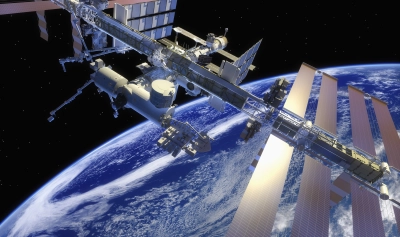


The scientific device DropCoal (Droplet Coalescence), developed entirely in Romania by Romanian InSpace Engineering (RISE), as part of a project funded by the European Space Agency (ESA) and proposed by an international team of researchers led by the National Institute for Laser, Plasma & Radiation Physics (INFLPR) Romania, was launched on Tuesday to the International Space Station, informs a press release sent to AGERPRES.
The launch took place on Tuesday from NASA Kennedy Space Center, with the equipment inside the Dragon capsule mounted on a Falcon-9 rocket (as part of the SpaceX CRS-31 mission). The experiment will arrive at the ISS on Tuesday evening, where it is to be installed by astronaut Donald Pettit in the European Physiology Module in the Columbus laboratory, on the ICE Cubes Facility.
"DropCoal was designed to study the coalescence and mixing of liquids during a 6-month mission aboard the International Space Station. Specifically, throughout the entire mission, the device will run 560 experiments, which involve generating two droplets of different substances, filming with an ultra-fast camera how they coalesce and mix in the microgravity environment. The discoveries from this experiment are of particular importance for space exploration, as they will help scientists improve the way astronauts take medicines or fuel different spacecraft," the cited source says.
According to the cited source, RISE designed and built the apparatus needed to carry out the experiment. It includes an ultra-fast video camera, a fluid circulation system, pumps, high-precision motors to control the movement of the droplets towards each other.
"The droplet formation is carried out through advanced software and is controlled by an operations center installed in the RISE lab," the same source said.
To qualify for launch, the device underwent a test campaign as required by ESA and NASA. This campaign included checks for: resistance to vibration during launch, operation over the entire temperature range, electromagnetic compatibility with the ISS and compatibility with the communications interface.


The team of scientists who proposed the experiment is led by experts from the National Institute for Laser, Plasma & Radiation Physics (INFLPR) Romania in collaboration with the Technical University of Darmstadt (Germany) and Carnegie Mellon University (USA).
A space mission operated entirely from Romania, DropCoal will run scientific experiments for 6 months on board the Station.
DropCoal is thus the first complete space mission, from concept to operation and scientific data processing, developed in Romania as a member state of the European Space Agency (ESA).
The project is fully funded by the European Space Agency and is in line with the Romanian Space Agency's (ROSA) efforts to develop the space field in Romania.





















Comentează