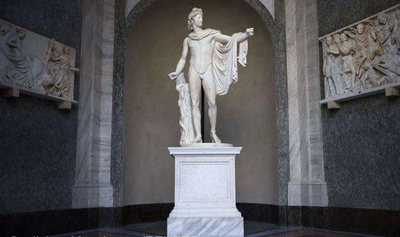


The manifesto-exhibition "Vienna's Borrowed Gods. Petrified Witnesses", recently opened at the National Museum of Banat (MNB) in Timisoara, invites the public on a journey through the mythology of Antiquity, among the fantastic figures of the Greek and Roman pantheon, where more than one hundred art and documentary photographs by Austrian art and theater photographer Christine de Grancy await discovery.
This manifesto-exhibition draws attention in an unusual and striking way, not only to architectural beauty, but above all to the importance of safeguarding cultural heritage.
And because Timisoara is also known as "Little Vienna", thanks to its architectural treasures inspired by the buildings of the Habsburg Court from the 18th to early 20th centuries, the exhibition also becomes a challenge to local authorities and residents to look more closely at their own architectural legacy, as Timisoara holds the largest number of historical buildings in Romania - over 10,000 monuments and sites.
Stepping into the exhibition venue in the MNB Attic, the visitor learns that in 1975 Christine de Grancy climbed onto the roof of Vienna's theater and discovered a true epic unfolding above the city. She followed the monumental works crowning the rooftops of the Theatre, the Parliament, the City Hall, the Palace of Justice and other surrounding institutions, creating genuine photographic narratives.
Leafing through the catalogues, the itinerary carries one on a fabulous journey, a tour of imperial Vienna viewed from the rooftops, where one encounters, among others, the imposing god of the North Wind, Boreas, atop the Burgtheater, magnificently concealing the building's air-purification system; Apollo, god of the arts; Artemis/Diana, goddess of the hunt, on the Parliament roof; Nike, symbol of Victory; Pallas Athena/Minerva, goddess of wisdom; Ares/Mars, the fierce god of war; and Atlas, the eternal bearer.
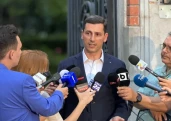
Andrei Popov, deputy director and press officer of the Austrian Cultural Forum in Bucharest, told AGERPRES that these stone deities remain completely unseen by tourists, and even by ordinary Viennese, as one would need the keys to the doors leading to the rooftops of the city's emblematic palaces and edifices to properly gaze upon them.
"It's a fascinating project, born at the crossroads of historical documentary art, semiology and anthropology, in 1975, when Christine de Grancy - one of the world's most remarkable art photographers - climbed onto the roof of the Burgtheater to see where an air vent led. And thus she discovered that one end of the ventilation tube serving the hall emerged in the funnel of the god Boreas, the North Wind, whose sculpted figure still stands on the theatre's roof. That moment marked the beginning of her exploration of the rooftops. She climbed these buildings until around 2020, constantly discovering new territories and adding new photographs. The exhibition begins with Boreas and continues with relatively recent images, up to 2018. The rest belong to her personal archive, not shown here in full. This exhibition has traveled widely across Europe and the world; it is a manifesto, both for a way of seeing the world, for heritage and its preservation, and for people, because every photographed element tells a story of a political, social or artistic time, of relationships between people that differ greatly from those we maintain today. It is extremely interesting to see how this historical dimension evolves from the 18th century to the present, what power meant then, and what it means now," Popov explains.

He also clarifies why these are Vienna's "borrowed gods": because all these figures come from Greek and Roman mythology.
"Practically none of these gods belong to the mythology or cultural imagination of Germanic peoples. That is why it is so intriguing to ask, for example, why the roof of the Vienna Parliament features Nike eight times, in different poses and contexts. Or why Pallas Athena stands atop a central Viennese building. Even petrified, these gods send a message. They are more than symbols of an era or an imaginary world. These statues speak, very concretely, about status, power, and the relationship between society and its ruling class," the Austrian Cultural Forum official emphasizes.
Popov also notes that in Timisoara, similar statues can be found on heritage buildings erected during the Habsburg rule, though many are now in danger of collapse and loss.
"For this reason, we should all lift our gaze from the ground beneath our feet, for we will discover architectural jewels, masterpieces neglected by passers-by, and realize that we are surrounded by value. Timisoara earned its nickname 'Little Vienna' because its architectural and urban structure resembles Vienna's. After visitors from other cities saw this exhibition, they began to look up at walls and rooftops to see what was there. I believe this is the exhibition's most important message and greatest gift: it invites you to look, to truly see, to rediscover your city with completely different eyes. That, in my view, is its greatest achievement: teaching us to appreciate what we have, our heritage," Andrei Popov concludes.
The exhibition "Vienna's Borrowed Gods. Petrified Witnesses", organized by the Austrian Cultural Forum in Bucharest, can be visited until March 29.