



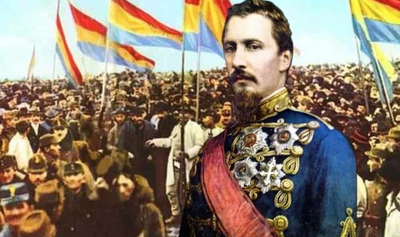


In the deposits and exhibition halls of the Vrancea Region Museum in Focsani, the Union of the Romanian Principalities is no longer just a chapter in a history book, but a succession of fragile, personal, often emotion-laden objects that anchor a political ideal in the lives of real people - each with their own paths, choices and destinies.
From revolutionary publications printed in the feverish days of 1848 to intimate belongings of Prince Alexandru Ioan Cuza and his wife Elena, the museum's heritage patiently reconstructs the atmosphere of the era in which the modern Romanian state took shape.
Museographer Mariana Corina Duca explained for AGERPRES that the period of the struggle for Union (1848 - 1859) is illustrated through rare documents of exceptional historical and symbolic value.
"The Vrancea Museum holds copies of the revolutionary newspaper 'Pruncul român' from August 1848, an extremely rare publication capturing the radicalism and hopes of the 1848 generation. We also have 'Protestation in the Name of Moldavia, Humanity and God', written and signed by poet and revolutionary Vasile Alecsandri in May 1848 - a document of remarkable rhetorical force. We keep Bulletins of the Ad-hoc Council of Moldavia, where deputies from Putna County are mentioned, as well as publications such as 'The Peasants' Question', printed in Paris in 1857, and the 'Regulations of the Ad-hoc Council in Bucharest'. All of this shows that the Union was not a spontaneous act, but the result of a highly articulated political and intellectual effort," the museographer said.
Ruler Cuza's era is brought to life through documents and objects that draw visitors closer to the daily world of the political elites of the time.
"We have a telegraphic dispatch sent by Mihail Kogalniceanu to Gheorghe Ilie, the deputy of Focsani elected to the Ad-hoc Council of Moldavia, bearing Kogalniceanu's signature and dating from before the administrative unification of Focsani. We also have a receipt signed by Alexandru Ioan Cuza on November 12, 1865. These documents speak not only of major decisions, but of the concrete mechanisms of power. We also preserve personal objects of the ruler: books from his library, household items bearing the Cuza monogram, clothing pieces, and objects belonging to Elena Cuza - a lace umbrella and a purse with silver elements - details that humanize a historical figure often wrapped in idealization," Duca added.
A separate chapter is dedicated to the unionist families of former Putna County, presented through original documents and personal belongings. Among them, the Apostoleanu family holds a central place.
"We focused on the Apostoleanu family because Gheorghe and Smaranda Apostoleanu embody the unionist elite of the province. We hold their original marriage certificate from October 1859, an extremely fragile document preserved with great care. Gheorghe Apostoleanu was a lawyer, briefly Minister of Justice of Moldavia, and a multi-term parliamentarian. Smaranda Apostoleanu distinguished herself through remarkable charitable work: she supported the education of poor girls and helped raise funds for the 1877 War of Independence, including donations to the Romanian Red Cross, then in its infancy in the county," the museographer explained.

The museum's heritage also includes objects belonging to members of the Central Commission - pocket watches, pipes, snuffboxes - as well as pieces documenting the networks of influence of the era. The most important item linked to the Commission's activity in Focsani is a draft Constitution authored by Mihail Kogalniceanu, preserved in its original form. The project was never adopted, failing to pass the political tests of its time, but remains a revolutionary document for its era.
The oldest and most valuable photograph in the collection is a daguerreotype depicting Eliza Dascalescu, a figure who connects local history to major names in Romanian culture.
"The daguerreotype shows Eliza Dascalescu, daughter of prefect Constantin Robescu, wife of unionist Dimitrie Dascalescu, and future mother-in-law of architect Ion Mincu. It is an exceptional piece, not only for its age, but for the bridges it builds between political and cultural history. Such objects reveal how interconnected the elites of the time were and how significant Focsani was in this process," Duca noted.
The museum is also preparing a modern component for showcasing its heritage: a digital interface dedicated to unionist personalities from former Putna County.
"It is a presentation created with the help of artificial intelligence, highlighting Apostoleanu, Dascalescu and the village yeoman Ioan Roata. It is our way of telling history in the language of today's generations, without losing scientific rigor. The Union must not only be commemorated, but understood," the museographer added.
Behind the display cases, the Vrancea Museum still guards numerous undeciphered documents and multilingual correspondence - including letters from Kogalniceanu - currently under research and digitization. For the museum's specialists, each object is a fragment of a puzzle still incomplete, yet essential for understanding how the Union of the Principalities came to life.















Comentează