



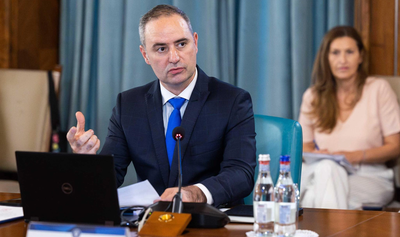


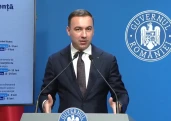
Our growth model has relied for too long on consumption fuelled by ever-increasing external fiscal deficits, eroding the economic fundamentals, and what Romania is experiencing today is not a crisis, but the anticipated consequence of a deliberate paradigm shift, Finance Minister Alexandru Nazare said on Tuesday.
"In the past two decades, Romania has achieved remarkable income convergence, supported by European integration. However, as the World Bank reports also show, this progress has been accompanied by increasingly pronounced macroeconomic imbalances and visible regional disparities. (...) The transition from middle-income to high-income status is neither automatic nor guaranteed. I know that the 0.6 percent growth recorded in 2025 and the technical recession in the second half of the year have raised legitimate questions. But I say this very clearly: what Romania is experiencing today is not a crisis. It is the anticipated, and in some cases necessary, consequence of a deliberate paradigm shift. For too long, our growth model relied on consumption fuelled by ever-increasing external fiscal deficits. This fiscal model was an illusion of prosperity, eroding, at the same time, our economic fundamentals. We have chosen to correct this direction, and such correction inevitably comes with transitional costs. In today's Europe, in today's world, under geopolitical pressures with increasingly restrictive financial conditions and a new competitiveness agenda, economic growth can no longer be bought with deficit, it must be earned through productivity," the minister explained at the debate called "Romania: Economic Growth Driven by Competitiveness" organised by Romania's Government in partnership with the World Bank Group, agerpres reports.
He underscored that the consolidation effort implemented in 2025 and 2026 is perhaps the most ambitious in Romania's post-accession history and the results confirm the validity of the approach: by the end of 2025, the cash budget deficit fell to 7.7 percent of GDP, well below the 8.4 percent target, representing an adjustment of approximately 1.6 percentage points compared with 2024.
The minister also pointed out that personnel expenditures were reduced by 0.6 percent of GDP, while public investment was protected.
"Fiscal consolidation is, however, a means, not an end in itself. The real challenge that brings us together today is to build a growth model that not only recovers but transforms - a model that shifts Romania from deficit-driven demand to production-based competitiveness. This is the logic behind the comprehensive economic recovery package adopted last week," Finance Minister Alexandru Nazare mentioned.
He brought to mind several elements of this package, which "fundamentally change the terms of the issue." For the first time, Romania has a dedicated instrument to attract large-scale strategic investments exceeding 200 million euro, through a combination of grants, tax credits, state guarantees and, where appropriate, equity participation, according to Finance Minister Alexandru Nazare.


"It is an instrument that, in my view, we have lacked for years, and its absence has cost us real opportunities. The total envelope until 2032 for all support programmes amounts to 5 billion euro and the funds will be channelled towards support schemes in seven priority sectors, including critical raw materials, new technologies, defence, research and development.
We are also significantly updating support for innovation. Romania already had facilities for research and development, such as the additional 50 percent deduction or income tax exemption for research personnel, but the novelty we have introduced is this 10 percent tax credit for research and development, which directly reduces the tax liability and sends a strong signal of predictability to investors," the Finance minister said.
Alongside this, he also mentioned the Hub Romania scheme, which supports innovative SMEs with grants and a deduction of up to 200 percent for tangible and intangible assets in frontier technologies, such as artificial intelligence, biotechnology and advanced robotics.
"These instruments are designed to accelerate the journey from the laboratory to the market, where the European innovation landscape still ranks Romania as an emerging innovator, at around 38 percent of the European Union average," Alexandru Nazare said.
The minister added that on the financing side, a super-accelerated depreciation of 65 percent has been introduced for assets acquired in 2026, a 1 percent flat tax for micro-enterprises, and a 3 percent bonus for on-time payment of tax obligations for both legal entities and self-employed individuals. Moreover, the threshold for VAT on collections has been raised, the Investment and Development Bank has been capitalised and guarantees have been introduced to catalyse private lending for productive investments.
The Finance minister also pointed out that Romania's IT sector is among the most dynamic in Europe and digitalisation is no longer merely an administrative modernisation project, it is macroeconomic policy, adding that, through the recovery package, the fiscal policy becomes a tool for technological transformation, not merely a source of revenue. According to him, Romania's reform agenda is firmly part of the wider European debate.
"The response must be European in scale, but national in execution. In the ECOFIN [Economic and Financial Affairs Council] and in recent intensive discussions with the OECD [Organisation for Economic Co-operation and Development], we have consistently advocated for the completion of the Capital Markets Union, for rebalancing the tax burden from labour towards consumption and capital, and for a stronger European framework to support competitiveness. We therefore welcome the idea of a European Competitiveness Fund within the next multiannual financial framework, which aligns closely with the sectors we are already prioritising in the recovery plan: critical materials, defence, research and development, and new technologies," Nazare said.
Minister Nazare mentioned that Romania is not just a beneficiary of European solidarity, pointing to the IT industry, Romania's geostrategic position and human capital as the real assets in the equation of European competitiveness.
"Our strategy is based on three priorities: prioritising investment over current and consumption spending, maximising the absorption and impact of European funds, and implementing structural reforms to make markets more competitive and the economy more shock-resilient. The pace of technological and geopolitical changes in an increasingly volatile world, as we have seen in recent days, means the cost of delayed or half-implemented reforms rises year by year. I would tell our partners, let us rewrite this transition together, with clear priorities, realistic timelines and expertise brought to the table in advance, while options remain open. (...) Our level of ambition is not only for Romania to join the group of high-income countries, but for Romania to contribute decisively to the goal of a more competitive and resilient Europe," Finance Minister Alexandru Nazare conveyed.


















Comentează