



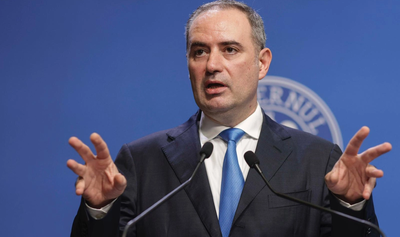


The real risk for Romania is not a temporary 'technical recession' but a reversal of the fiscal adjustment process and any deviation from the consolidation path would erode investor confidence, increase financing costs and put pressure on the country's rating, Finance Minister Alexandru Nazare said on Friday.
According to him, the data published on Friday by the National Institute of Statistics (INS) show a cyclical adjustment, in the context of the historic deficit and the measures taken last year, as well as real growth in Romania's economy.
'Romania maintains growth of 0.6% in 2025 and returns to the right track, despite the budgetary irresponsibility of recent years. Romanians need balance and concrete facts, not false alarms. I have carefully analysed the data published today by the INS and we are constantly monitoring the various ways in which they are interpreted in the public space. What do the data actually show? A cyclical adjustment, in the context of the historic deficit and the measures taken last year and real growth of Romania's economy. Small growth, but real - and this is the true message for Romanians, not false alarms circulated in the public space without a full analysis of the data and the context,' Nazare wrote on his Facebook page.
He underlined that the positive GDP dynamics of 0.6%, very close to that of 2024 (0.9%), despite the difficult context faced last year, demonstrate that Romania's economy continues to grow and that this 'is the result of more efficient management of public funds and of an honest business environment' which has continued to perform even under stress conditions.
The Finance minister added that Romania's economy will also grow in 2026 by at least 1%, this being the forecast of the Romanian authorities as well as of major international institutions - the International Monetary Fund, the World Bank and the European Commission.


'It is time for us, too, to have more confidence in Romania - from within - especially as our major international partners already do,' Nazare pointed out.
At the same time, he signalled that there was a real temporary slowdown between two quarters of last year, of approximately -0.1% in the third quarter and -1.9% in the final quarter and explained that the phenomenon is correlated with natural adjustments: companies selling stocks, more prudent consumption, corrections after years of consumption-driven accelerated growth.
'But Romania is not in an economic crisis. The statistical definition published today describes two consecutive quarters of seasonally adjusted GDP decline and is not a verdict on (...),' the Finance minister maintains.
According to him, all the data presented on Friday are the assumed effect of 'a natural recalibration of the economy through responsible measures imposed by the context of a long period of budgetary slippages.'
Alexandru Nazare also mentioned that investments are steadily increasing, with public investment as the central pillar, which in 2025 reached a historic record of over 138 billion lei, funds that are already being felt and will continue to have an impact in the period ahead, exports are supporting the economy, rising by 4.2% in 2025 and significantly outpacing the dynamics of imports (2.6%), unemployment remains at a low rate of around 6%, according to the International Labour Office methodology, with no serious losses or concerns on the labour market and household bank deposits are increasing, 'a sign of stability and prudence.'
He warned that the real risk for Romania is not a temporary 'technical recession' but the reversal of the fiscal adjustment process.
'Any deviation from the consolidation path would erode investor confidence, increase financing costs, put pressure on the country's rating and expose the economy to a much harsher adjustment imposed by the markets. Budgetary discipline is the condition of stability, not an obstacle to growth. After more than 35 years of transition, instability and continuous shocks, Romanians do not need stress and false alarms. They need more seriousness and concrete facts. And the facts clearly show that the economy has slightly slowed its pace but is consolidating on healthier foundations and continues to grow, supported by investment, more efficient management of public funds and strategic measures,' Alexandru Nazare stressed.
Romania's economy grew by 0.6% in 2025 but ended the year in a technical recession after gross domestic product (GDP) was 1.9% lower in the fourth quarter compared with the third quarter of 2025, marking the second consecutive quarter of decline, according to flash data published by the National Institute of Statistics on Friday.





















Comentează