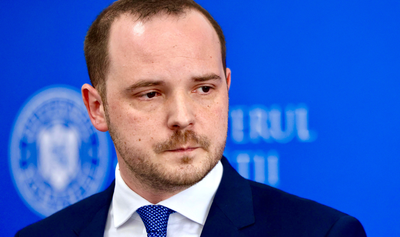


Health Minister Alexandru Rogobete said on Wednesday that the third contract with Pfizer had been signed without a clear needs assessment and that the figures had been overestimated.
In his view, the COVID-19 vaccination campaign was "a failure".
"It is obvious that the number of vaccine doses from Pfizer alone far exceeds Romania's population, even including booster shots," the minister said.
He noted that the additional 29 million doses were no longer necessary from a public health perspective, given that previously ordered vaccines were already beginning to expire, vaccination rates were declining, and the virus was no longer as severe as in earlier stages of the pandemic.
"The decision of the Brussels tribunal refers strictly to the 29 million doses that were not ordered and were not delivered to Romania, but which were part of the contract signed in May 2021. (...) Let us recall the situation towards the end of 2022 and in 2023: there was a significant stock of unused vaccines, amounting to several million doses, many of which were beginning to expire. Vaccination rates were falling, and COVID-19 was no longer as severe as in 2020-2021. Therefore, these additional millions of doses were no longer necessary from a public health standpoint. I am not saying whether the decision was right or wrong. (...) What was wrong, in my view, was the enormous quantity agreed in May 2021, which had no connection to reality and no medical estimation directly linked to public health needs or vaccination rates," Rogobete explained.
He stressed that the 29 million doses were not merely ordered but contractually committed, meaning Romania was obliged to pay for them even if they were not requested for delivery.
"Had these doses not been contracted in May 2021, Romania would not now be facing a bill of 3 billion lei. It is true that at the time we did not know how the pandemic would evolve. However, it was obvious that in May 2021 we knew the country's population would not double, given that these vaccine doses ordered in addition to the existing ones amounted to nearly 30 million doses already contracted. And importantly: this concerns Pfizer alone. Let us not forget that we have three additional contracts with three other manufacturers. So we are talking about an order of roughly 30 million doses placed in May 2021 on top of another order of approximately 30 million doses," said Health Minister Alexandru Rogobete.
He also pointed out that renegotiation at the time would not have eliminated the obligation to receive the doses.
"Renegotiation would have meant purchasing them at a reduced price. In practice, Romania would still have had to buy the 29 million doses, store them and also pay for their disposal. Therefore, it would not necessarily have been a fiscal advantage," Rogobete said.
The minister recalled that the case is currently under investigation by the National Anticorruption Directorate (DNA).
He further emphasised that the ruling by the Brussels tribunal is enforceable, meaning Romania will have to pay the amount regardless of whether an appeal is filed.


"Whether or not an appeal is lodged, Romania will have to pay this amount. If the appeal is successful, the funds will be returned. But yes, this is an enforceable decision. (...) In the coming period, we will analyse all the details, including penalties, how they will be calculated, and how the situation will evolve in the near future," Rogobete said.
A Brussels court on Wednesday ordered Poland and Romania, at first instance, to pay outstanding amounts for COVID-19 vaccines ordered from Pfizer/BioNTech, totalling 1.3 billion euros and 600 million euros respectively, according to a court statement cited by AFP. A