



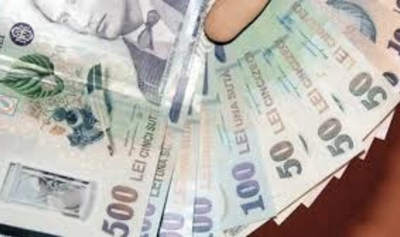


The impact of the fiscal adjustment measures in Romania will be more pronounced this year and will be felt especially as a restricted purchasing power of the population, as a result of high inflation in the first part of the year and a falling disposable income of households, according to the autumn forecast of the National Economic Strategy and Forecast Board (CNSP).
Under the current scenario, the level of economic growth in 2026 is forecast at 1%, slightly down from to the estimates of last summer's forecast of 1.2%. Construction remains the most dynamic sector, while the population's inclination towards consumption will be significantly reduced.
"In terms of activities, construction remains the most dynamic sector, supported by the continuation of infrastructure projects financed by European funds. A slight recovery in the industrial sector and services is to be expected, but their dynamics remain modest. On the demand side, amid the conclusion of the National Recovery and Resilience Programme (end of 2026), an acceleration of pace is expected in terms of the absorption of funds allocated through the Next Generation EU instrument, which, through responsible management, will generate an advance of 4.0% in gross investments. However, there is a risk of underusage of European funds, which would constitute a vulnerability on the evolution of the investment process and implicitly on economic growth," says CNSP.
In the current economic context, affected by measures to reduce the budget deficit, the population's inclination towards consumption will be significantly reduced, implicitly determining a pronounced deceleration of private consumption (-0.8%).
Net exports, as a result of a 2.7% increase in exports of goods and services, at the same time as a slower advance in imports of goods and services (+1.2%) resulting from restricted domestic demand, will have a positive contribution of 0.5% to the real economic growth rate.
The economic evolution subject to investment risks for 2026 has led to a negative revision of the projection on the monthly number of employees, which at the annual average level will lead to a stagnation of the number of employees, as against a0.5% increase in the previous forecast. In the medium term, however, a slight growth trend is anticipated, in correlation with the advance of the economy, so that the number of employees will increase at an average annual rate of 1.2%.


As for the average gross wage earnings, an increase of 5.5% is expected for 2026, to RON 9192 a month, given the behaviour of the competitive sector in correlating wage indexations for inflation and with the minimum wage policy, but also a slight decrease in earnings in the public sector as an effect of fiscal consolidation measures. Moving forward, an average annual dynamic of 5.7% is expected, accompanied by an increase in yhe purchasing power and the return of the disinflationary process.
According to the CNSP, as far as the developments in the macroeconomic indicators in the medium term (2027-2029) are concerned, the current scenario foresees an attenuating domestic macroeconomic context, with corrections for internal and external deficits, which will support an average annual growth rate of gross domestic product slightly above 2%. Construction will continue to represent the most dynamic activity in the economy, with an average annual rate of the period higher than the gross domestic product (2.8%). The estimates in the autumn forecast foresee, in the medium term, the recovery of the industrial sector, with an annual rate of around 2%, and for services, after the modest developments in the period 2025 - 2026, they are expected to rebound, mainly through the performance of high-value activities.
On the demand side, gross investments, at an average annual rate of 2.7%, will continue to represent the pillar of support for economic growth, with special attention being paid to the allocation of available resources, both from European, governmental and private funds, for the completion of major infrastructure projects. Private consumption, after a decline in 2026, will advance at an average annual rate of 2.6%, 0.4 % above that of the gross domestic product.
Net exports will have, in the medium term, a negative contribution of about 0.2% to economic growth, the average dynamics of imports of goods and services (3.3%) being 0.1% ahead of that of exports of goods and services (3.2%).
As for inflation, the board draws attention to the risk of additional pressures on prices that may come from the re-liberalisation of natural gas prices and the elimination of the cap on markups on basic foodstuffs.
"The inflationary process will subside throughout the forecast period, except for the first half of 2026, when the effects of the measures to increase fiscal sustainability and the re-liberalisation of the energy market this year will be temporarily felt. However, the risk of further pressure on consumer price growth for 2026 remains, stemming from the re-liberalisation of natural gas prices and the abandonment of the cap on markup on basic foodstuffs. These shocks could produce a moderation of the disinflationary process and a broader contraction on household consumption. According to the estimated trajectory, it is expected that inflation at the end of the year will fall, starting with 2027, within the margins of the inflation target set by the National Bank of Romania."
Thus, the annual inflation rate is estimated at 3.6% in 2025, down from 9.6% in 2025 and 3% in 2027.
For the leu/euro exchange rate, an average annual depreciation of 1% was assumed for the forecast interval. For 2026, the average exchange rate is estimated at 5.11 lei/euro.
Externally, the medium-term current account deficit will continue a correction process, more pronounced in 2026, being supported both by measures to narrow the government deficit, by an increasing absorption of European funds, and by the improvement of the external competitiveness of domestic goods. The 2026 current account deficit is estimated at 6.6% of GDP, as against 8% of GDP in 2025.




















Comentează