



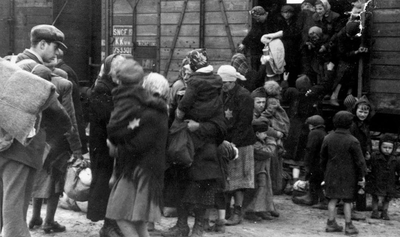


The Romanian Cultural Institute (ICR) and its branches in Berlin, Chisinau, London, Tel Aviv, New York, Paris, Stockholm, Warsaw and Vienna are marking International Holocaust Remembrance Day through cultural events dedicated to the victims of the Holocaust, with a focus on the history of Jews in Romania, also including another minority group persecuted by the Nazis - the Roma.
"The date on which, in 1945, the Auschwitz-Birkenau extermination camp was liberated represents an opportunity to reflect on the consequences of intolerance and discrimination, as well as a moment for debate, remembrance and the rediscovery of historical facts, contributing to a better understanding and acknowledgement of the past," the Romanian Cultural Institute (ICR) said in a press release sent on Monday.
In this context, on 27 January, between 12:00 and 18:00, the Romanian Cultural Institute will present the virtual reality experience Human Violins - Prelude in the Grand Hall at 38 Aleea Alexandru, Bucharest. Created by Romanian artist Ioana Mischie, the work is described as "a profound visual and sound creation that explores the transformative power of music in the darkest moments of history".
The immersive event is organised in partnership with the I.L. Caragiale National University of Theatre and Film and offers the public a contemporary form of commemoration through art and technology.
The Mihai Eminescu Romanian Cultural Institute in Chisinau, alongside the Orthodox Jewish religious organisation Agudat Israel of the Republic of Moldova, will organise on 26 January, at 15:00, at the Agency for Interethnic Relations in Chisinau, the conference On The Roads of Death in Bessarabia, delivered by Nicolae Dragusin, PhD in Philosophy and doctoral candidate in Political Science.
The event will also feature the presentation of the virtual map Roads of Death in Bessarabia, a historical documentation initiative mapping the routes of deportations of Jews from northern Bessarabia to camps in Transnistria. The biographical short film The Ice Cream Man (2024), written and directed by Robert Moniot, will also be screened.

Also on 27 January, at Cineplex Loteanu in Chisinau, the historical drama La Rafle (2010), directed by Roselyne Bosch, will be screened. The film depicts the largest roundup and mass arrest of Jews carried out in France during the Second World War, in 1942.
The Romanian Cultural Institute in Tel Aviv will organise an event on 27 January at its headquarters, featuring Dr Ana Barbulescu from the Elie Wiesel National Institute for the Study of the Holocaust in Romania and Professor Silviu Rogobete from the West University of Timisoara.
At the Romanian Cultural Institute in New York, the event Benjamin Fondane and Paul Celan - Literature, Memory and Exile will take place on 29 January in the Norman Manea Hall, dedicated to the lives and works of the two Jewish writers of Romanian origin. The programme will include presentations and public readings from selected works by both authors.
The Romanian Cultural Institute in Stockholm will host, on 29 January at its headquarters, an evening of commemoration and dialogue bringing together researcher and activist of Roma origin Delia Grigore, President of the Roma Centre Association Amare Rromentza, and Swedish writer and activist of Roma origin Fred Taikon, President of the association E Romani Glinda. The discussion, held in English, will focus on the volume The Holocaust against the Roma: an album of memory and gratitude and the bilingual children's book The Ring with a Horse's Head.
On this occasion, the opening of an exhibition dedicated to the Holocaust against the Roma in Romania will also take place. The exhibition was produced by E Romani Glinda in collaboration with the Roma Social-Cultural Foundation Ion Cioaba and The Virtual Museum of the Roma Holocaust. The documentary film Roma Tears (2006), directed by Luminita Cioaba, will also be screened.
The Romanian Cultural Institute in London and the Romanian Embassy in London will organise, on 30 January at the Institute's headquarters, the project The Holocaust against the Roma, consisting of a round table followed by the presentation of the volume The Holocaust against the Roma: an album of memory and gratitude.
The Romanian Cultural Institute in Vienna, in collaboration with the Cultural Association Iancu Tucarman and Maria Popa, will organise on 30 January, at the Bosendorfer Salon, a concert in memory of the victims of the Holocaust, performed by Mihaela Manea (piano) and Arnold Plankensteiner (clarinet).
The Titu Maiorescu Romanian Cultural Institute in Berlin, in collaboration with the Romanian Embassy in the Federal Republic of Germany, will organise on 3 February, at the Neue Synagoge Berlin - Centrum Judaicum, the debate Mirrored Violence: Kristallnacht (1938) and the Bucharest Pogrom (1941), followed by the German premiere screening of the documentary The Rebellion and the Pogrom, produced by Romanian Television in 2026.
The Romanian Cultural Institute in Warsaw, together with the Brama Grodzka - Teatr NN Centre and the Central Europe Institute in Lublin, will organise on 5 February an event dedicated to the Bucharest Pogrom, marking 85 years since the events, while also commemorating International Holocaust Remembrance Day. In Poland, the day is marked each year on 27 January by a solemn ceremony at the former Nazi concentration camp Auschwitz-Birkenau.
The event will include a debate hosted by the Brama Grodzka Centre, followed by a screening of the documentary The Rebellion and the Pogrom, produced by Romanian Television in January 2026.
The Romanian Cultural Institute in Paris organised on 25 January, in the Golden Salon of the Behague Palace, the concert The Troubadours of the Resistance, performed by Duo Goldstein - pianist Angela Draghicescu Goldstein and violist Elias Goldstein. "The event aimed to recover a little-known repertoire created in direct connection with the Holocaust, as a form of cultural resistance in the face of barbarity and as a conscious effort to preserve a memory and identity threatened with total annihilation," the press release said.
The Romanian Cultural Institute is a member of the Interministerial Committee monitoring the implementation of the 2024-2027 National Strategy for preventing and combating antisemitism, xenophobia, radicalisation and hate speech, and is directly involved in carrying out a series of actions under the Strategy's Action Plan, the source added.






















Comentează