



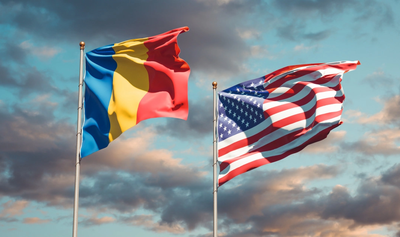


The partnership between the United States of America and Romania has never been stronger and more important, said Darryl Nirenberg, the U.S. Ambassador to Bucharest, in an interview with the AGERPRES National Press Agency.
The American diplomat emphasized that Romania "is an incredible partner of the US and the role it plays is essential, especially in the Black Sea region and on the Eastern Flank" of the North Atlantic Alliance.
At the same time, he said that Romania has the potential to be a game changer in the energy field in Central and Eastern Europe.
This is the first interview that the American diplomat gives to the Romanian media since taking office in Bucharest.
AGERPRES: Mr. Ambassador, recently the National Security Council of Romania approved the use of U.S. military bases for the support of U. S. military regarding the conflict in the Middle East. Could you elaborate on that? What does this mean concretely? Because there are speculations that there may be deployment of American soldiers through these bases. Could you elaborate that and could you clear this out?
Darryl Nirenberg: First of all I would say what an honor it is for President Trump to have selected me to be his personal representative here in Romania. I'm gratified, humbled by President Trump and Secretary Rubio placing their confidence in me for such an important post to such a remarkable country.
We have a strong strategic partnership which celebrates its 30th anniversary. And this is broad-based. It covers defense, security, law enforcement, but also commercial relationships and people-to-people engagement. I'm proud to be here for that, but also proud to be here to help carry out President Trump's America First foreign policy, which is rooted in sovereignty and is we're here to make America safer, stronger, and more prosperous. When it comes to Romania, that means looking at our shared interests, our shared values which derive from Western civilization, looking to build our relationship and also promote respect for fundamental freedoms.If I could give you a little bit of background, and let me jump into questions as well. So, in preparation for my service here, I met with six former U.S. ambassadors to Romania.

AGERPRES: Could you name them?
Darryl Nirenberg: I have private conversations and I would ask them to . What was really interesting is I talked to my fellow ambassadorial nominees and nobody else had had that experience. And part of it's because there's something special about serving here that have the former ambassadors all like a clique. They engage with each other. But they'd talk to each other and when I'd talk to one, they'd say, oh yeah, you have to talk to this other one. Some of the former ambassadors I talked to multiple times. Then we also talked to friends who had been here, and then in preparation for coming, preparation for serving, did a great amount of reading and studying, as did my wife. So we came here with very high expectations, and those high expectations have been exceeded. People are warm and the partnership between our countries is so strong and broad-based.
AGERPRES: Could we go back to the question? WE were talking about the U.S.-Romania partnership and the recent decision of Romania to use the military bases for helping U.S. troops in the conflict in the Middle East.
Darryl Nirenberg: So since the very first day I arrived here, I have been impressed by the depth of our strategic partnership. This week, I'm looking forward to visiting our troops at Mihail Kogalniceanu Air Base. And our country is grateful to Romania for its role in hosting American troops in a number of locations. Our partnership, it has never been stronger, and it's never been more important. So I am glad to be here at this point in time.
AGERPRES: Could you elaborate on this commitment of Romania to help the U.S. troops through the American bases?
Darryl Nirenberg: President Trump has laid out very clear objectives. He has spoken with the media on numerous occasions. So with respect to our operations related to Iran, I will refer you to his comments. But he has been very clear that the United States' commitment to NATO in Article 5 is ironclad.
AGERPRES: Because you were talking about President Trump's declarations: last week there was something President Trump said, that he's a little bit disappointed with the NATO allies because they didn't get engaged as much as he wanted in the Middle East conflict. And will the U.S., given this context, will the U.S. remain as engaged within NATO, do you think?
Darryl Nirenberg: So I'll refer you again to his comments, and also he has made clear that his commitment to NATO and Article 5 is ironclad, our country's commitment. I will point out that when it comes to NATO, Romania is an important NATO ally, part because of its location, but also because it has stepped up. It has exceeded its 2% commitment [to defnse spending] and it supported the United States at the Hague last year in bringing NATO's commitment to 5% and is on the way to meeting that commitment. And it's important that NATO does meet that commitment for both security reasons for NATO, but also for the sustainability for NATO that countries in NATO begin to step up to provide as well.
AGERPRES: In May, there will be the B9 meeting, the Bucharest 9 meeting. And there's information that President Trump was invited at this meeting. Could you give extra information about that? It is this question of President Trump's presence or Secretary Rubio's presence?
Darryl Nirenberg: First, we're delighted that Romania is hosting this meeting, and it's a mark of Romania's leadership on the eastern flank and security. I have nothing to confirm regarding the invitation. I will point out that prior to me coming here, there's a long history of very high-level officials coming to visit Romania, whether they are administration officials, congressional officials, or military or law enforcement. So in preparation for my confirmation, getting prepared to serve here was like studying for the bar. I'm a lawyer. Only it was much more intense and in depth than studying for the Bar. So one of the things I did in preparation is look to see which members of Congress had been here in recent years. A number of members have been here, and also the members who have been here have been high visibility members who have great out back in DC. So I've been able to meet with, I was able to meet prior to coming here, have consultations with a number of members who had visit here. And they all had a fairly uniform message, which was Romania is an incredible partner to the United States and the role they're playing in terms of security is essential, especially in Black Sea region and the eastern flank.
AGERPRES: There are efforts regarding a bilateral of President Nicusor Dan and President Trump in Washington D.C. Do you have extra information on that?
Darryl Nirenberg: So I do not have any additional information on that. But I will note that this is a building relationship between President Dan and President Trump. That we were pleased to see President Dan attend the Board of Peace initiative, the first inaugural meeting. And where he had time with President Trump and separately with Secretary Rubio. My understanding is shared with President Trump that Romania is willing to help. Note the First Lady [Mirabela Gradinaru, President Dan's life partner] was just this past week in Washington at First Lady Melania Trump's initiative and had a speaking role and was very well received. This follows on conversations President Trump has had with President Dan, including a call upon his inauguration congratulating President Dan.
AGERPRES: When it comes to this bilateral visit that will happen, I don't know when. There are two topics that Romanians think about, there's the visa waiver file and there's also the file of the annulled elections that was actually commented by American politicians. The first question would be, is still the subject of the annulled presidential elections in Romania, is it still part of the discussion at high level when it comes to American politicians? A question of interest?
Darryl Nirenberg: As I had just mentioned. President Dan received a call from President Trump. There is the concept that among the values we share, are the inherent rights of people and freedoms, including the freedom of expression. in all walks of society, including politics, and the United States supports that strongly. Point out this, that America's relationship with Europe is very important because we share certain fundamental values that derive from Western civilization. And if we want this relationship to be sustained over the long term, it cannot be a transactional relationship. It needs to be something that is based on shared values, the values of Western civilization and the values which Romanians and Americans share.
AGERPRES: Do American politicians consider that the annulment of the Romanian elections was a democratic fact?
Darryl Nirenberg: Like I said, is that President Trump and President talked after the presidential election, and the values of free expression is important to our country in all contexts, including in the political sphere.
AGERPRES: And regarding the Visa Waiver, because Romania was about to obtain the visa waiver status. The Romanians didn't, and there was a wave of disappointment in a way.
Darryl Nirenberg: So at the outset, the United States is grateful to Romania for its continuing cooperation on issues related to border security. The decision on the Visa Waiver program was done as part of a global review and that Romania is welcome to reapply. I will point out that there are opportunities for Romanians to visit the United States, provided that they meet the requirements of our laws. And our laws are very strict and clear on this. I've been down to our windows here where Romanians are lining up for visas, both on the outside and the inside to watch it. So those windows are open and I would encourage anyone who wishes to visit the United States to partake of that opportunity.
One of the things that I'll point out is, shortly after I came here, maybe about 10 days ago, we hosted an event where we invited students who are participating in the summer work program in the United States and alums of that program to come to our embassy. And it was one of the most fun activities in which I've engaged since I've been here. My colleagues were pushing me to leave already because I enjoyed talking to the students and alums as much as I did. But what struck me was how uniformly the students, or the alums, and many of the students are returning, or both alums and going again, how universal their experience was in the United States. They had been to incredible places, some of which I've always wanted to go to but have never had the opportunity. Regardless of the job they had, their experiences were positive, and they were all anxious to those returning to return. They very much enjoyed learning about our country and also getting to experience people-to-people relations firsthand. And so the fact that they come back with such positive experiences and they're sharing it with their colleagues and families and friends is important to us in building those people-to-people ties.
AGERPRES: When it comes to the revisiting of the visa waiver, is there a time frame for this, as far as you know?
Darryl Nirenberg: I do know that Romania is welcome to reapply. I'm not familiar with the exact timelines under the law.
AGERPRES: Recently, Romania was part of a meeting in the U.S. regarding the rare minerals. Could you elaborate on that?
Darryl Nirenberg: Critical minerals are essential for our future because modern electronics are so reliant on it. And it's important to have secure supply chains. So we have a partnership to address those. So at the early stages with respect to that partnership. But I was very glad to see Foreign Minister Toiu come to D.C. to attend that first ministerial in which she actively participated. And it was my first occasion to meet with her. I was able to pull her aside and introduce myself. So it's an item of cooperation with the United States and I'm looking forward to working on it.
AGERPRES: Romania and the U.S. have an important collaboration regarding the SMRs, the nuclear energy. What is the US focusing on? Will the oil crisis in the present context actually enhance this collaboration? Because we're talking about nuclear energy.
Darryl Nirenberg: At a foundational level, when it comes to energy, Romania has the potential to be a game changer. Here in Central Eastern Europe, developing the Romanian economy, and in reducing dependency on Russia. As President Trump has said, energy security is national security. And as you know, President Trump has put significant focus on energy dominance part because energy security is national security, but also because energy is so key to powering economic development. Romania has multiple resources they are tapping and also have the potential to tap in the future. A nuclear program is one that holds great promise. We're very happy that the United States companies and U.S. technology, Western technology is part of the refurbishment of the nuclear reactors at Cernavoda.
And with respect to the SMR, as you we know, have an intergovernmental agreement that calls for pursuing SMR technology with U.S. technology. Pleased to see the initial decisions have been made and proud to see that U.S. companies are the ones providing the cutting-edge technology. Also note that the Exim Bank and the Development Finance Corporation have committed up to USD 3 and USD 1 billion, respectively, to support an SMR project.
AGERPRES: And this brings us into the wider range of U.S.-Romania economic relationships. What are the topics that should be enhanced and what are the topics at their highest when it comes to bilateral economic relationships?
Darryl Nirenberg: If I could digress for a minute and talk some about my personal background, because it does dovetail into economic opportunities. So as you picked up from the video I was born in a small town. When I was young, my father had a heart attack when he was 37 years old. It was not fatal, but it limited his ability to work. And when I was 14 years old, he pulled me aside and he said, We're doing okay, but I'm not sure there will be enough to pay for you and your two younger brothers' educations. So if you're thinking of going to college, and I hope you will, you need to start earning the money to go. And that's your obligation as a firstborn.'
So being in a small community people pull together, they support each other. And so from that time on, I always had jobs, whether it was shoveling snow in the winter, mowing lawns in the summer, delivered groceries, started a paper route, painted the inside of our schools, ended up bussing tables and then eventually waiting on tables. When I went off to college, I started my own business. And it was selling premium candies at a roadside stand. It gave me a fast lesson in benefits of the free enterprise system and entrepreneurship. Because that summer the stand was so successful that after a month, I was able to hire my younger brother to work there. I was able to scale it by having an interest in a stand elsewhere in New York State, and it ended up paying for the rest of my college almost all the way through my senior year.
When I graduated from college, I got my old jalopy. I drove to Washington, D.C. the day I graduated. Most people go on vacation after they graduate. I went right to Washington. My car broke down on the beltway around Washington, D.C., but I made it to a friend's apartment where he had graciously allowed me to sleep on his couch until I found work. Got a job back waiting on tables. What was the Keybridge Marriott? It was the second Marriott Hotel. It was Bill Marriott's favorite. And then within a few days, got a job working on Capitol Hill, working for a senator. And that kicked off my 40-year career, both in public sector and private sector, working on foreign policy, international law and trade. The opportunities the free enterprise system provides is personal to me. There's tremendous opportunity when it comes to commercial relationships between the United States and Romania.
Our relationship has grown three times over over the past 18 years. We are now the fourth largest investor in Romania, the largest outside the EU. As I mentioned, in particular with energy, Romania has potential to be a game changer. And there's over 1,000 U.S. companies that are present here. And we have U.S.-companies in a partner nation, especially at the level we have here. It creates jobs both here in Romania and back home in the United States. It builds relationships outside of the official channels and also with the official channels. It also shares the vibrancy, the energy, the innovation that comes with the free enterprise system.
AGERPRES: Regarding the bilateral relationship, it's also an economic relationship. Could you talk a little bit about military acquisitions? What's the future of military acquisitions from Romania to the U.S.? Because now there's the SAFE program encouraging Europe to Europe acquisitions?
Darryl Nirenberg: We appreciate that Romania is in the midst of spending over USD 20 billion on American solutions for defense and energy security. (...) That's great for the partnership because American technology is the best. And it's crucial for NATO's performance function for there to be interoperability.
Among the large-ticket items, you see the F-35s that have been contracted for, and we're hopeful a second tranche will be subsequent, and also Abrams tanks, which they'll be training for here as well. Regarding the SAFE program, I know there are American companies that are being engaged in co-production opportunities, which we support.
We talk about big-ticket items, but there's also other items. Just this past week, I had the pleasure and honor to be at a ceremony commemorating the delivery to Romania's armed services, armed forces, of Shield AI's V-BAT system. It is a system which is drone-like. It is vertical, so it's vertical takeoff and landing, and it got a camera in it. And the camera is incredible high resolution. So what it is is it is an airborne surveillance system which is unmanned. And it extends the range of surveillance significantly at a relatively low cost. I believe it can be kinetic as well. So this means can be turned into reconnaissance just by having one of these on its deck. Ground forces can use these without needing a runway typically associated with drones. So not only is Romania receiving these, but Romania is going to be the regional hub for other countries here that are going to be acquiring it. So we'll be providing the training, etcetera, out of Romania. That's just one example.
AGERPRES: Because we are neighboring Ukraine and the war in Ukraine, could you talk about the US's overall about the US support towards Ukraine, especially in the framework of the situation in the Middle East? Is it a question of either or? Specifically, if the U.S. is involved in the Middle East, does that mean it won't be as involved in Ukraine?
Darryl Nirenberg: President Trump has been clear that this war must end, and it must end in a just and lasting peace. This is something he has been clear since the time of his campaign, and I know it's been a priority since after the election. With respect to Iran and Ukraine. I'll refer you to Secretary Rubio's comments this weekend.
AGERPRES: Well, actually, he said something that - he was talking about the fact that the Allies did not get involved into Iran, and he said, well, we got involved into Ukraine, which is not our war. So do you have anything to dd about that?
Darryl Nirenberg: No. But I would point out his other comments about how our commitment to seeking an end to that conflict remains a priority.
AGERPRES: And if it doesn't end, will the U.S. still support Ukraine?
Darryl Nirenberg: President Trump has been very clear that reaching a lasting, sustainable peace and just peace is a priority of his. I will point out, though, that Romania has played a key role in this conflict. Accepting refugees, facilitating the shipment of grain at a very crucial time, which has benefited not just Ukraine, but the world as a whole. Donating equipment, training training pilots, F-16s pilots. In fact, President Zelenskiy was here here at a the a few couple weeks ago and built on that partnership.
AGERPRES: Do you you want to to add anything else?
Darryl Nirenberg: When President President Trump selected selected me to come here, I was thrilled. Thrilled because my grandparents came from this region. And the values they passed on to us, I was very fortunate that we had grandparents who lived in our small town as I grew up. And the values, they passed on to us were values from Eastern Europe of importance of faith, family, honoring one's heritage and hard work ethic.
When I was on the Senate Foreign Relations Committee, one of major events, milestone events in history that occurred during my tenure there was the Romanians winning their freedom from communism. It was something that we were watching very closely because of course it was the last of the Warsaw Pact countries to do so, but also because the lead senator on our side of the aisle was very focused on Romania because of the brutality of the Ceausescu regime. And because of ties his state's faith community had with the faith community here. I still remember exactly where I was when I heard that the revolution had been undertaken.
The other day I had the pleasure of attending an event at the National Library to commemorate the opening of a founding father's exhibit commemorating our 250th anniversary, 'Freedom 250'. I was given a tour. They have portraits or pictures of each of the individuals who signed the Declaration of Independence. And they have these QR codes you can go to, and it downloads an AI of that founding father talking. As we were going through the exhibit, the person who was our host was highlighting the personal risks that a number of these founding fathers faced in terms of their liberty, their faith, their family and the sacrifices they made.
Later on during that reception, I was talking to a gentleman who had been here at the time of the 1989 Revolution. And he told me what the consequences were for him. And it struck me that here we are looking at the founding fathers of America, the people who made our country possible, and the sacrifices they made, and there are people right here, right now, who have made sacrifices to free the country from communism and pursue freedom.
I was thrilled with the selection to come here, and I'm even more thrilled to be here.
While my foremost priority as ambassador will always be the safety, security, and well-being of Americans in Romania, I look forward to advancing President Trump's America first foreign policy in three key areas.
First, strengthening our defense and security partnership as NATO Allies. Our robust security cooperation underpins the U.S.-Romania alliance, and I will further President Trump's objective to advance this cooperation at a critical moment.
Second is to build on our economic and commercial opportunities, including, and especially in energy, critical minerals, and technology. I am committed to promoting American business to create jobs in both the United States and Romania, and to strengthening ties that benefit both our nations.
And third, further deepening the people-to-people ties that bind us together. Our educational and cultural programs reflect our shared civilizational values help create the special enduring bond between the people of the United States and the people of Romania.
******* The diplomat congratulated the AGERPRES National News Agencyon its 137th anniversary, calling it quite and achievement today.













Comentează