



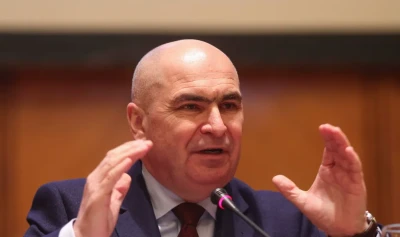


The European Union's eastern border must be strengthened in the coming years through a combination of enhanced military and economic security, as one cannot function effectively without the other, Prime Minister Ilie Bolojan said on Tuesday.
He is taking part in the Government Roundtable entitled 'South-East Europe's Next Leap Forward' (Romania Government Roundtable), an event organised by The Economist Group.
'The European Union's eastern border will remain, for many years to come - as it already is today - the Union's most important frontier. Of course, the other borders are also important; we have issues in the Mediterranean area, particularly regarding illegal migration. However, from a strategic perspective - economically, militarily and in terms of defence - this border, from the Baltic to the Black Sea, is the most important in the years ahead. This is because we cannot assume that Russia's behaviour will become predictable again in the coming years, given what has happened recently. We must consider what a zone of instability in Ukraine in the years ahead would mean for Europe's security. From this perspective, I believe the eastern border must be stronger and more reinforced in the coming years. Such a border can only be strengthened through a combination of military and economic security, because one does not work without the other,' said Ilie Bolojan.
He added that no region lacking a certain level of security will attract significant investment capable of generating safety and prosperity for its inhabitants.
'No region that lacks adequate infrastructure - a combination of civilian and military infrastructure - and does not have at least a minimally developed industrial base capable of supporting defence can be reliably protected. From this point of view, the combination of economic development and strengthened defence is the safest way to ensure that the eastern border becomes stronger,' Bolojan stressed.
He also pointed out that another very important aspect concerns EU enlargement, which has contributed - and will continue to contribute - to supporting the Union's competitiveness.
'Of course, competitiveness does not depend solely on enlargement; it depends on many factors described by prime ministers and experts. However, enlargement has supported competitiveness throughout these years. If we consider expanded markets, consumers, labour, and the extension of European industrial value chains, this has helped those value chains remain competitive. What has happened, for example, in the automotive industry and other sectors that extended their production chains into Eastern Europe following enlargement has contributed to sustaining the European Union's competitiveness,' Bolojan noted.
According to the Prime Minister, the lagging behind of Eastern European countries, beyond historical and geographical factors, is also due to a deficit in good governance.
'All countries that joined the European Union have, through good governance practices and EU rules, experienced improvements in the quality of governance - regardless of political orientation or governing cycles - which have stimulated economic development, improved quality of life, and raised living standards,' he said.


The head of government also highlighted the benefits Romania has gained from EU accession.
'Romania is such an example, having significantly improved its quality of life, indicators, gross domestic product, and convergence since joining the Union in 2007. I believe this applies equally to countries where the Union may expand. Enlargement is not merely an act of generosity, as it might be perceived from a certain perspective, but an important strategic decision that we support. It is not just an expense, as it might appear in a simplistic accounting framework, but an investment in the EU's development in the years ahead and an important step towards competitiveness, a safer region in this part of the world, larger markets, and a stronger European Union,' Bolojan added.






















Comentează