



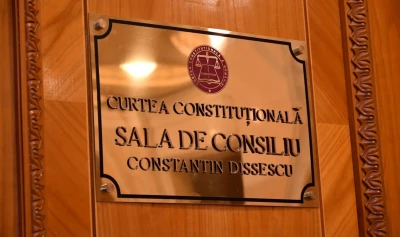


The four judges who boycotted the Constitutional Court sessions complain that they were called to work on Sunday, a non-working day, "an unprecedented fact in the procedure for resolving objections to unconstitutionality", adding that their absence did not mean a blockage of the Court's activity, Agerpres reports.
Judges proposed by the PSD to the Constitutional Court - Cristian Deliorga, Gheorghe Stan, Bogdan Licu and Mihai Busuioc - gave the public, on Monday, a point of view regarding the repeated postponements of the debates on the new project of the Bologna Government regarding the reform of magistrates' pensions.
On Sunday, they left the meeting during the debates and did not return, and on Monday they did not show up at all.
"The complaint regarding the objection of unconstitutionality of the Law on amending and supplementing certain normative acts in the field of service pensions was registered on the docket of the Constitutional Court on Friday, December 5, at 2:45 p.m. On the same day, the President of the Constitutional Court, Simina Tanasescu, appointed herself as the judge-rapporteur in the case and set a hearing date for the file for December 10, less than 3 working days later, an unprecedented fact in the jurisprudence of the Constitutional Court. On December 10, since the report drawn up in the case was incomplete, the file was postponed. The President of the Court set the new deadline for December 28, a non-working day, Sunday, which is also unprecedented in the procedure for resolving objections to unconstitutionality. Even though the judges present at the hearing requested a postponement for a day in January, since all the other cases pending in the hearing of December 10 were postponed to January 22, 2026, the President of the Constitutional Court refused to proceed in a similar manner," say the four constitutional judges.
They add that during the Sunday deliberation session, pursuant to art. 58 paragraph (3) of Law no. 47/1992 (which provides that in the situation in which a judge requests the interruption of the deliberation for a better study of the issues that form the subject of the debate and at least one third of the number of judges of the Plenum considers the request justified, the ruling shall be postponed to another date), a judge requested the postponement of the ruling and three other judges supported his request, the reason for the postponement being to request a point of view through which the Government would publicly clarify that the law does not modify aspects of the service pension, but effectively abrogates this right of magistrates, consolidated over time through a rich jurisprudence of the Constitutional Court. The judge-rapporteur was also asked to complete the report in order to clarify the proposed solutions for each criticism of unconstitutionality formulated.
"The request formulated based on the legal and regulatory provisions was ignored by the Court's management, which refused without justification to apply the provisions of art. 58 paragraph (3) of Law no. 47/1992 and to set a new deadline for resolution. Consequently, four judges left the courtroom, so that the provisions of art. 51 paragraph (1) of Law no. 47/1992, which provide that the constitutional court works legally in the presence of two-thirds of the number of judges, became incidents. We immediately submitted a written request to the office of the President of the Court, in which we reiterated the application and observance of the legal provisions. Subsequently, we were informed that the President had set a deadline for resolving the case for the next day, Monday," the judges mentioned.


Consequently, they say, the absence from the December 29th session "did not mean a blockage of the Court's activity, but a decision related to respecting the operating rules and the legal framework that governs the activity of the Constitutional Court of Romania".
"Making a decision at an accelerated pace, with deadlines set from one day to the next, departs from the usual practice of the Court and risks affecting the quality of deliberation. Participation in such a session would have been equivalent to accepting a procedure considered inconsistent with the law and the rules of procedure of the Court, and not with the responsible exercise of the mandate of a constitutional judge. Compliance with the rules is not a formality, but a guarantee of the correctness and credibility of the Court's decisions, and the conduct adopted had as its sole purpose the protection of these principles. In cases of such importance, the time necessary for reflection and real debate is a condition for the proper functioning of the rule of law, not an impediment," emphasize the four judges.
The present clarifications express exclusively the position of the authors and do not represent an official communication from the Constitutional Court, they point out.
The clarifications come after the president of the CCR, Simina Tanasescu, stated on Monday that there is no need for an impact study in the case of the new project of the Bologna Government regarding the reform of magistrates' pensions




























Comentează