



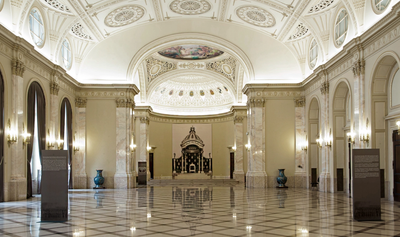


Erwin Kessler, art critic and historian and director general of the National Museum of Art of Romania (MNAR), says that one cannot approach the ie (Romanian blouse, ed.n) starting only from its image, as it is represented in art.
'IA la descusut' (IA unpicked, ed.note) is a symposium in which the unpicking is done by those who usually deal with sewing it, ethnographers and ethnologists. We, those in the area of art history, deal with looking, we do not literally unpick, but they will carry out this unpicking, a term that none of us would have allowed ourselves to use, even those who in their daily professional lives are involved in repairing, preserving and restoring works of art that contain textiles. You cannot approach the ie starting only from its image, as it is represented in art, which is the subject of our exhibition, RomaniA. The identity representation of traditional costume in art',' said Erwin Kessler, PhD., who is also the curator of the exhibition at MNAR, agerpres reports.
Florica Zaharia, PhD., Conservator Emeritus at The Metropolitan Museum of Art and director, president and co-owner of the Textile Museum and the Textile Heritage Preservation Association in Baita, Hunedoara, said that the event hosted by MNAR 'demonstrates once again that what we see here and what our predecessors left us are works of art.'
'One of the things we hope to bring new information about today is precisely the ie, what the ie is, how we define the ie and so on. The materials are extremely important and, as I was saying, this is a relatively new trend, it has happened in the past but we see it today worldwide and we hope in Romania as well, at least this is what we do at the Textile Museum. We look at the elements that make up the Romanian shirt, because they are linked to a geographical space and to a certain technology. We are talking about fibres, dyes, pigments if necessary and textile structures. Until now we have looked at the surface of the artefact and at the historical context, but now it is time to look beyond this surface of our beautiful shirt,' said Florica Zaharia, PhD.
In a recorded message, Simona-Mirela Miculescu, Romania's Ambassador Extraordinary and Plenipotentiary and Permanent Delegate to UNESCO, said that the initiative to organise the event in connection with National Culture Day is not a coincidence but a recognition of the role that intangible cultural heritage plays in expressing the country's identity.

'Culture builds bridges between people and nations, culture contributes to the promotion of peace, mutual respect and dialogue, it is a common good of humanity that teaches us to look at the past with respect, the present with clarity and the future with responsibility. Passing on over time traditions, customs, practices and crafts specific to intangible cultural heritage represents the way to ensure the continuity of these ancestral elements and to project towards the present and the future the specificity of our communities in the Carpathian-Danubian-Pontic area,' said Ambassador Simona-Mirela Miculescu.
The symposium was also attended by Ioan-Aurel Pop, President of the Romanian Academy, Irina Petroviciu, chemical researcher at the National Museum of Romania's History, Iulia Teodorescu, textile restorer at the ASTRA National Museum Complex in Sibiu, Mirela Cretu, PhD., director of the Collections Management Department at the ASTRA National Museum Complex in Sibiu, Doina Dascalu Isfanoni, Phd., graduate in art history and theory at the Nicolae Grigorescu Institute of Fine Arts in Bucharest, Ion Cherciu, Phd., ethnographer, researcher and expert of the Ministry of Culture for the areas of vernacular architecture, ethnographic assets and old Romanian art, and Andreea Diana Tanasescu, PhD., initiator of the Universal Day of the Ie and founder of the international community La Blouse Roumaine.












Comentează