



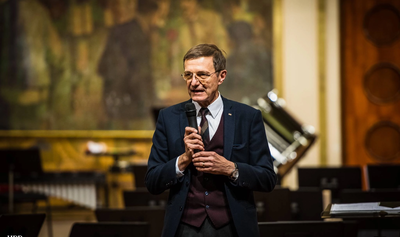


Eminescu is himself, in essence, the eulogy and praise of the Romanian people, President of the Romanian Academy Ioan-Aurel Pop says in a statement to AGERPRES on the occasion of National Culture Day, stressing that it is necessary to value our values 'as they are' and to cultivate our language 'like a honeycomb' everywhere, in the country and around the world.
'The fact that we celebrate culture on Mihai Eminescu's birthday is not a coincidence. Of all Romanian spiritual creators, the most representative is, without doubt, Eminescu. He was not declared the prototype or symbol of Romanian culture by any authority nor imposed by any state institution, but by life itself, by the great collective personality of the Romanian people and, therefore, he cannot be judged, admonished or brought down from his pedestal by anyone's will. Eminescu expresses in his work, in nuce, the entire history of Romanian and European culture. Eminescu has classical verses like those of Ovid, the one immortalised at Tomis. He sings of gallant love and the honour of medieval knights as the troubadours and trouveres once did, he details the Middle Ages of Alexandru cel Bun, from 1400, just as Victor Hugo did in Notre-Dame de Paris' for the French space,' Ioan-Aurel Pop pointed out.
Eminescu, the academician says, also anticipates the world of the future, criticising the political scene and projecting, through the perception of the speed of light and through the ideational universe of a world in eternal motion, Romanian cultural and scientific creation into the third millennium.
'Eminescu, born on a precise date, 15 January 1850, and in a specific place, in the Upper Country of Moldavia, ended his writing together with his earthly Christ-like age, but was touched by the angel's wing of eternity. Eminescu is European because he expresses the essence of the Romanian spirit and he is the most representative Romanian creator because he fitted into the European common denominator,' said Ioan-Aurel Pop.
Eminescu, the President of the Academy says, does not need praise or eulogies, but "Eminescu is himself, in essence, the eulogy and praise of the Romanian people.'
The National Culture Day also represents the celebration of the language in which this culture is expressed, the Academy President also said.

'The Romanian Academy has been striving for over a century and a half to create culture, to value validated Romanian intellectual creation from all times and to prepare the premises for our future spiritual works. Today, National Culture Day is also the celebration of the language in which this culture is expressed, it is the celebration of spiritual creation as a superior form of expressing the values of the soul by great creators. We pay tribute to all of them and, in particular, to the one who placed Romanian verse and language on an untouchable pedestal, Mihai Eminescu,' conveyed the President of the Romanian Academy, who considers it 'natural' that in the Republic of Moldova, whose official language is also the one in which Eminescu wrote, National Culture Day should be the same as the homonymous celebration in Romania.
Since 15 January 2011, Romanian culture has benefited from an official celebration with national status, established on the anniversary of the poet Mihai Eminescu. National Culture Day was initiated by academician Eugen Simion, President of the Romanian Academy at the time, and was enacted by the Romanian Parliament in 2010. Now in its 16th edition, National Culture Day is celebrated in all communities inhabited by Romanians, inside or outside the country's borders.














Comentează