



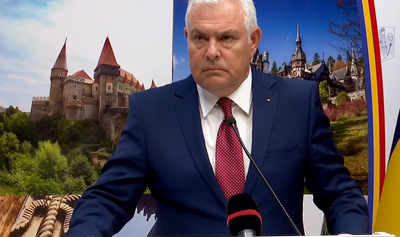


AGERPRES special correspondent Florin Stefan reports: The mobility corridor agreed on Wednesday by Romania, together with Bulgaria and Greece, on the sidelines of the NATO summit in Washington, is one of NATO relevance, Defense Minister Angel Tilvar said on Thursday, who added that NATO is expected to get involved in the initiative, including financially.
"I want to tell you that one of the things I agreed together with my counterparts from Bulgaria and Greece refers to mobility", Angel Tilvar told a briefing for Romanian journalists, adding that "behind the preparation, training and regional plans also have a component, let's say logistics, a component related to supply, maintaining supply chains, ensuring the infrastructure necessary for mobility, which is of great importance and which contributes to the good equation of the decisions taken".
The minister also stated that "it is very good that we obtained this corridor and the approval for it, because it will be a corridor of NATO relevance. So, we expect NATO to get involved, including financially".
Asked if there are certain constraints that the builders will have for the implementation of this infrastructure, Tilvar explained that "it is about certain requirements that are relevant in terms of their use and from a military point of view".
Regarding the time horizon that this modernization process would entail, Tilvar said that this is something that is dealt with by experts, "after the decision has been taken at our level".
On Wednesday, Tilvar signed the letter of intent for the creation of a military mobility corridor between Romania, Bulgaria and Greece, according to a press release from the Ministry of Defense.


The project aims to optimize transport corridors to meet military mobility requirements, by creating supply routes (road and rail) between the participating states, reducing bureaucracy during peacetime and maximizing efficiency in emergency and crisis situations, taking into account the NATO and national initiatives.
The project will benefit from existing initiatives at the level of the European Union, aiming at a coordinated approach between NATO and the EU in the field of military mobility. The implementation of the project at the national level will require concerted efforts between various institutions, involving the entire governmental spectrum, according to the cited source.



























Comentează