



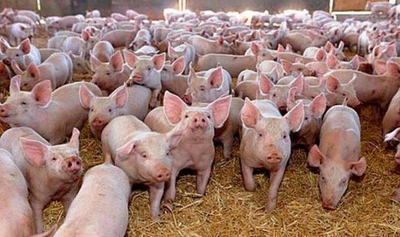


The pig farming sector produces the largest losses in Romania's trade balance, with an annual deficit of over 1.2 billion euros, said Mihai Neagu, director of the Animal Husbandry Directorate of the Ministry of Agriculture and Rural Development (MADR) on Tuesday.
"Public policies are mainly directed towards deficit sectors, towards those that bring imbalance in the trade balance and, at the same time, towards sectors that have potential. If we look at the trade balance, we will see that the biggest loss comes from the pig farming sector, somewhere around 1.2 - 1.3 billion euros annually, and from the milk production sector, especially dairy products. We have potential in the poultry sector, mainly, discussing the livestock sector, and in the plant sector, where we all know that grain exports are quite important. As public policies, we are mainly directed towards the investment area to cover these deficits and stimulate areas with potential. For this, we have started investment programs, both from the national budget and from European funds," said Mihai Neagu, at a debate organized by the Chamber of Commerce and Industry Romanian-German AHK Romania, on the occasion of the launch of the Agri-Food Policy Brief.
He mentioned that, for the pig breeding sector, there is an ongoing program to establish 46,000 accommodation and breeding places for sows.
"We consider it a successful program, started in 2018 and still ongoing. To give you an idea, in terms of size, the number of sows in commercial farms in Romania, at this time, is somewhere around 105,000 heads. 46,000 new heads means a significant contribution. So far we have approximately 11,000 places completed. This year we will complete another 23,000, with the remaining approximately 11,000 to be completed next year. Also, in the poultry sector we have a similar investment program, also started in 2018, which is ongoing. We have almost 3,000,000 accommodation places in different elements of the poultry sector - incubation, broilers, reproduction, laying hens -, totaling, at the end of the program, approximately "8,000,000 accommodation places. This would be a line we could follow in an economically sustainable way, to cover the deficit," said Mihai Neagu.
He also stated that the Ministry of Agriculture is trying to support niche production, production that can have value at the local level and can involve several sectors. In this regard, support has been offered for pig breeders of the Bazna and Mangalita breeds for several years.
"Here too we had satisfactory results. We started the program, if I remember correctly, with approximately 300 sows, and currently we have over 800 sows," added Mihai Neagu.
The Romanian-German Chamber of Commerce and Industry AHK Romania launches on Tuesday the Agri-Food Policy Brief, a document containing proposals for improving public policies in the agri-food field.

The Agri-Food Policy Brief document is the result of the collaboration initiated by AHK Romania, between member companies - agricultural input producers, farmers, retailers - and several associations from the agri-food industry.
The initiative aims to create a framework for debate between the public and private sectors, to increase the competitiveness and resilience of the agri-food chain in Romania.




















Comentează