



Actions such as psychological or physical violence, mistreatment, sexual abuse or other forms of serious failure of care represent the legal grounds for the release of care orders, and the Norwegian Child Welfare Act has no provision allowing for alternative care based on religion, the Embassy of Norway in Bucharest said in release to AGERPRES this Wednesday.
According to data provided by the Embassy, in Norway, a care order is issued by a County Social Welfare Board or District Court, and only when the child is subject to serious neglect, maltreatment or abuse.
"Placing a child outside the home without the parents' consent is always a measure of last resort. A recent Council of Europe report shows that Norway is in the low range of countries with respect to the number of children in alternative care. Parents are entitled to a due process, including a lawyer paid for by the government, the right to be heard and the right to appeal the decision of the Board to the District Court. Parents can once a year file for a revocation of the care order," reads the release.
As for adoptions, the Embassy points out that normally, foster parents do not adopt their foster children, as "adoption is a very radical measure, which means severing of all legal ties between parents and children. This happens only in very few cases. Strict conditions must be satisfied to adopt a child against the will of the parents. The child welfare service shall normally not bring proceedings for approval of adoption against the parents' will where the relationship to the immigration law is not clear, or where it is clear that the child and the parents do not have permanent residence in Norway."
The Norwegian Child Welfare Act applies to all children in Norway, regardless of their background, nationality or residential status. The best interest of the child is the primary consideration in the work of the child welfare service. The child welfare service is primarily a help service for children and families. The child welfare system places great importance on family ties and continuity in the child's upbringing. The underlying assumption is that children should grow up with their parents," continues the release.
According to the cited source, the Ministry of Children, Equality and Social Inclusion is responsible for the general child welfare policy. The local child welfare services in the municipalities handles child welfare cases. The Ministry does not have the authority to intervene nor instruct the child welfare services in individual child welfare cases.
"The Norwegian authorities have a statutory duty of confidentiality regarding information in individual child welfare cases, in order to ensure children and parents personal privacy. Therefore, neither the child welfare authorities, nor the central Norwegian authorities can comment on the details of individual child welfare cases," points out the release.
It also argues that Norway has incorporated the UN Convention on the Rights of the Child into Norwegian law. The convention provides that the state where the child is present has a duty to protect children in accordance with its legislation.
"The Child Welfare Act is given priority through the Human Rights Act. The best interest of the child is also incorporated into our Constitution section 2014," reads the release.
The Embassy also offers a set of relevant statistical data, stating that each year approximately 53,000 children receive some kind of help from the child welfare service in Norway. More than seven out of ten of these cases were voluntarily assistive measures for children and families. Help may be provided in the form of advice and guidance to parents on parental practices, counseling, economic aid, kindergarten etc, reads the document.
The Embassy also states that the Norwegian Government has asked Parliament for consent to ratify the Hague Convention 1996 on the protection of children. Ratification will provide increased protection for children in cases related to more than one State, and open for increased international cooperation to prevent and resolve child welfare cases.
The Embassy adds that on its own initiative, it has reached out to the Romanian Ministry of Foreign Affairs, the Parliament and the Prime Minister's office to give information about the Norwegian Child Welfare Service, the principles upon which it is based, highlighting at the same time once more the principle of confidentiality.
Norwegian Embassy:Legal grounds for care orders are violence, mistreatment, sexual abuse, not religi
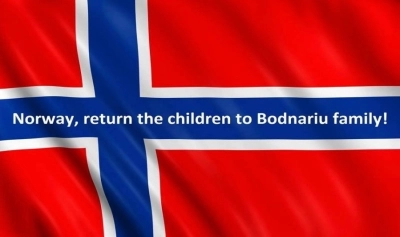
Sursă foto: stiripesurse.ro
Distribuie articolul


Distribuie articolul

Explorează subiectul

București 13°C
13°C
13°CArticole Similare

12
Film director Cristi Puiu: My path to cinema passed through painting; I never left the studio
12
17
Superior Council of Magistracy misses deadline on top prosecutor opinions; nominations proceed
17

19
ForMin Toiu in Bucha to commemorate four years since massacre: Any aggression must have consequences
19

24
Intelligent air defence system project wins EUDIS hackathon second edition
24

17
Sixth PSD regional meeting on Wednesday in Bucharest; internal referendum on 20 April on agenda
17

11
Romania, Ukraine discuss possibility of developing unmanned aircraft together
11

8
Romanian Academy to host major event on scientific research for 160th anniversary
8

24
ForMin Toiu reiterates Romania's support for Ukraine at informal meeting of Foreign Affairs Council in Kiev
24
23
“Family Footprints”: Students from Four Countries Explore Family Values through an eTwinning Project
23

19
Gov't approves memorandum for signing of EU-Mercosur Partnership Agreement
19

16
Customs authority, anti-corruption directorate sign collaboration protocol
16
23
EnerMin Ivan:Romania was attacked by Russian Federation 17 times in history, USA has always been an ally
23

13
Government: Capping of markup for basic foods extended until June 30
13














Comentează