






The economic survey dedicated to Romania, carried out by the Organisation for Economic Co-operation and Development (OECD), provides important recommendations for reforms in the fiscal and budgetary areas, for the labour market and for increasing the competitiveness of the economy and is a benchmark for economic stability and the modernisation of the state, Prime Minister Ilie Bolojan said on Monday.
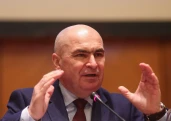
'I am pleased to participate today, alongside the Secretary-General of the Organisation for Economic Co-operation and Development, Mr Mathias Cormann, in the launch of the new edition of the OECD Economic Survey: Romania 2026. Since the opening of accession negotiations in January 2022, Romania has entered a process of evaluating its policies and practices against OECD standards in almost all areas of public policy. Owing to the joint effort of the institutions involved, our country has taken important steps in this accession process. The economic study we are launching today provides important recommendations for reforms in the fiscal and budgetary areas, for the labour market and for increasing the competitiveness of the economy. It is a benchmark for economic stability and the modernisation of the state,' Ilie Bolojan said at the Victoria Governmental Palace at the launch event of the Economic Survey: Romania 2026, drawn up by the OECD, agerpres reports.
He stressed that Romania's economic growth model must be based more on competitiveness and productivity.
'Romania is in a difficult economic context. After a period of accelerated growth but also fiscal imbalances, we are entering a stage in which sustainability is just as important as development. Our economic growth model must be based more on competitiveness and productivity,' Bolojan said.
In response to previous recommendations, Romania has taken important steps towards fiscal consolidation and reducing the budget deficit, the prime minister said.
'After a deficit of around 8.7% of GDP in 2024, the year 2025 ended with a deficit of 7.7%, below the 8.4% level estimated by the European Commission. We are continuing the reforms started last year and the draft budget for 2026 is realistic so that we reach the deficit target of 6.2% by the end of this year,' Bolojan explained.
He also said that, at economic level, the survey shows that Romania has withstood the shocks of recent years and the effects of the war in Ukraine.
'Economic growth slowed temporarily in 2025 due to fiscal adjustments and the economic situation in Europe. However, the outlook remains positive. Estimates show growth of around 0.7% in 2025 and about 1% in 2026, supported mainly by public investment and European funds,' Bolojan said.


In fiscal terms, the objective is to gradually reduce the deficit, use public money more efficiently and improve the absorption of European funds, he added.
'With regard to the labour market, Romania must respond to demographic pressures and labour shortages through policies in education and health and through measures to bring more people into the labour market. That is why it is necessary to gradually increase the retirement age in areas where people currently retire very early, sometimes even at 48 or 49 years old, in order to have more active people and a sustainable pension system in the long term,' Bolojan said.
At the same time, increasing the competitiveness of the economy remains a priority, he added.
'For this we need competitive costs, an efficient administration, clear rules and a modern and digitalised state. The ongoing reforms and investments, supported also through the National Recovery and Resilience Plan, aim to simplify procedures for companies, reduce bureaucracy and accelerate the digitalisation of public services. All these measures contribute to lowering costs for companies and to a more predictable economic environment. In parallel, Romania is accelerating the implementation of investment programmes financed by European funds, especially in transport infrastructure and the modernisation of electricity networks, areas that directly influence logistics costs, energy security and the competitiveness of firms,' Bolojan explained.
He also highlighted that the OECD study shows both the progress made by the country in recent years and the areas where further work is needed and that it is an important landmark for the reforms that must be implemented.
'Romania is undergoing a process of changing the way public finance and economic policies are managed. We must reduce the deficit, improve collection and use public money more efficiently. At the same time, monetary policy must remain prudent until inflation fully stabilises and structural reforms must continue. If we apply these reforms consistently, we can build a more stable, more competitive and more resilient economy,' Bolojan said.
The prime minister underlined the importance for Romania of the objective of OECD accession.
'Almost two decades after two defining moments, accession to the European Union and to NATO, Romania aims to achieve a new objective in 2026: accession to the OECD,' Bolojan said.
At the end of his speech, the prime minister thanked the OECD Secretary-General and the organisation's representatives for their cooperation with the Romanian authorities and highlighted Romania's progress in the accession process.
'We are at an advanced stage, we have completed 23 committees and we still have two committees left. I hope that together in the coming months we will be able to complete these stages as well,' Bolojan said.
He stressed that there has been agreement from all political forces regarding OECD accession.





















Comentează