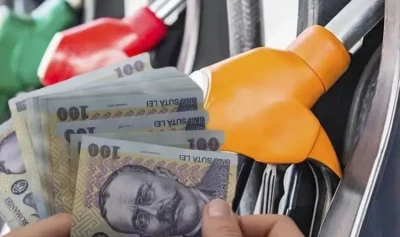


The increase in gasoline and diesel prices propagates to the costs of transport, agriculture, construction and trade, amplifying inflationary pressures on the economy and household budgets, says Chairman of the Smart Energy Association (AEI), Dumitru Chisalita, in an analysis on the impact of the increases at the pump.
"The price at the pump is increasing again. And it will surge. In an economy already strained by inflation, every 10-15 bani extra for fuel does not mean just an amount per receipt. It means a chain of price increases that propagates in food, transport, construction, agriculture. It means pressure on every family and every entrepreneur," says the specialist.
According to him, amid the volatility of the energy markets, the question arises increasingly more often of whether the full alignment of domestic prices with international ones is justified, given that part of the fuel comes from the domestic production of countries, with lower costs.
"But there is a question that is becoming increasingly difficult to ignore: is it justified to fully align international prices when part of the fuel comes from domestic production by countries, at much lower costs? In times of volatility, when external prices rise steeply, the difference between the real cost of domestic extraction and the final price can generate exceptional margins. This is no longer just "market alignment". It becomes crisis rent capture. Legal? Yes. Legitimate in a fragile social context? That is where the debate begins."
In his opinion, fuel is not just any product, but "a macroeconomic force."
"Each increase at the pump triggers a chain effect: hauliers increase tariffs, farmers bear higher costs for agricultural works, retailers increase shelf prices, builders adjust estimates, services become more expensive. Fuel is an inflation multiplier. When an integrated actor has the capacity to partially cushion the shock, but chooses to transmit the integral external pressure to the consumer, the impact is no longer only commercial. It becomes systemic."
The AEI official draws attention to the fact that, given that part of the fuel comes from the country's domestic production, the discrepancy between the economic situation of consumers and the financial results of companies in the sector can generate social tensions.


"Part of what ends up in Romanians' tanks comes from domestic production. While hauliers calculate survival from one day to the next, farmers reduce investment, small entrepreneurs cut margins, families squeeze their budgets, the financial reports of oil companies will indicate solid profits. This rupture between the reality at the pump and the reality on the balance sheet can create social tension. And the social tension does not disappear. It accumulates."
The analysis also mentions examples from the energy sector that, in times of volatility, used the advantage of domestic production to maintain competitive prices.
"There are precedents of responsibility. In difficult times, other energy companies stood in solidarity with Romanians, who also had the status of producers and demonstrated that the advantage of domestic production can be used in the interest of consumers: Hidroelectrica used its cost structure to offer competitive prices in a volatile context. Romgaz has played an active role in balancing the gas market and is developing its capacity to come up with lower prices to end consumers. These examples show that there is room for a different approach than simply instantaneous profit maximisation."
The analysis also indicates that ignoring the social dimension of rising fuel prices can generate reputational and economic risks for companies in the sector.
"Ignoring this social dimension is not without costs. Reputational risk and ESG. Investors are watching the social impact increasingly more closely. The profit derived in times of crisis can become a major image risk. Social pressure and consumer migration. Trust is hard to lose, and it is harder to regain. Boycotts are not a theory; they are a tool of the digital age. Political cost. No strategic company is immune when public opinion becomes hostile. In the short term, the maximum margin may seem reasonable. In the long term, it can become expensive."
According to the AEI chairman, the impact of fuels goes beyond the commercial dimension, being linked to the functioning of the entire economy.
"Behind a litre of fuel there is not just a price. There is a lorry that transports bread, an agricultural machine that works the fields, an entrepreneur who tries to stay competitive, a parent who takes the child to school. When fuel becomes a constant accelerator of inflation, society begins to look for culprits. A company that operates on the resources of a country cannot remain indifferent to this perception."
According to the analyst, a responsible approach does not imply decoupling from the international market, but temporary adjustments and greater transparency on the cost structure.
"Not complete decoupling from the international market. Not populism. Not sacrificing financial sustainability. But temporary margin adjustments in periods of shock, transparency on the cost structure, assuming the role of economic stabilizer. A voluntary gesture would change the perception of the company that it operates in a company, not just in a balance sheet," the specialist added.
Chisalita concludes by saying that the way companies manage these situations can influence their relationship with society.
"In normal times, the market decides. In difficult times, leaders decide. There is a choice between two paths: maximising profit amid the crisis in Iran, applying a Fair Price on Gasoline and Diesel. The resources belong to this country. The companies are Romanian. The consumers are of these countries. The impact is on these countries. The question is not whether the price can increase; the question is why it has to grow to the maximum possible when Romanians are suffering. And the answer to this question can define not only a financial quarter, but a relationship between a company and an entire society," says Chisalita.